Marcus Chan is a filmmaker who defies easy categorization; with a background in corporate law and a passion for storytelling that spans cultures and formats, he has built a career defined by both creative ambition and social awareness. As a director, editor, and advocate, Chan is known for portraying diverse characters in ways that emphasize shared humanity over stereotypes, crafting stories that are as technically refined as they are emotionally resonant. In this interview he reflects on the values that drive his work, the importance of representation without reduction, and how he continues to challenge boundaries in the world of film.
Your films often feature minority characters in leading roles without centering their stories on their minority status. What inspired this approach, and how do you balance authenticity with universality in your storytelling?
Representation of minority communities and their struggles is very important, and we as filmmakers should avoid reducing our characters to their minority status. At the end of the day, we are not “minorities” but individuals, and it is my belief that ultimately it is by focusing on the similarities between different groups (but without ignoring the differences) we can most effectively engage the audience, normalize so-called “minorities” and hopefully remove the barriers separating different communities.
“Palace” has been widely celebrated across major festivals. What was the genesis of that project, and what message were you most determined to communicate through it?
“Palace” was my UCLA MFA thesis film, and part of a class taught by James Franco. There were three of us in the class, and each of us was to adapt one of James’ short stories from his book “Actors Anonymous” into a short. The story I picked is essentially a dark tale about a powerful film director grooming young and vulnerable actors for ulterior purposes. It was made before #MeToo, and turned out to be quite relevant to the cultural discussions that emerged in the years that followed.
You’ve worked across genres—from psychological dramas to documentaries. How do you choose your projects, and is there a connective tissue that runs through all your work?
The more I work on documentaries, particularly as an editor, the more I come to believe that documentaries also operate with narrative arcs. Be it a scripted or unscripted / documentary project, I look for angles and stories that explore universal human traits that transcend cultural stereotypes because I believe they are what engage audiences and bring people together.
You’re known for being both creatively driven and technically masterful, particularly in editing. How does your work as an editor inform your directorial style?
When you also edit your own films, you know on set exactly what shot you need because you already have the edited movie playing in your head. That can really give you clarity and help you save a lot of time on set by getting rid of entire shots and setups that you don’t need. The flip side is that sometimes you may be so wed to the edited movie in your head you might miss creative opportunities, something I need to be constantly mindful of.
Having edited content for both major brands and indie films, how do you shift your technical and artistic mindset between commercial work and narrative film?
Commercials are usually about making a strong impression within a very short time and making that impression last. For narrative films, you usually already have the attention of your audience and it is about keeping their attention with your story and characters and eventually connecting with their emotions. You also have more time to achieve that. The two objectives are similar but also very different, and each demands its own pacing and editing strategy. It is important to keep that in mind throughout the creative and editing processes. One potential pitfall, especially in this day and age, is to assume the audience of your narrative film has the attention span of someone watching a TV commercial or YouTube video. Maybe that is true to some extent, but I also think it is important to have faith in your audience.
What advice would you give to aspiring editors hoping to enter today’s competitive landscape?
I think it is easy for new editors to get hung up on the technical side of editing – which is very important but probably not the most important – and neglecting the collaborative side of the job. It is not just about learning Avid or making the flashy cuts, but also about knowing how to work with your creative collaborators, listening to what they have to say and giving constructive advice.
Your work on documentaries like “Lviv Diary” and “2020: Chaos and Hope”, deals directly with political and social unrest. How do you approach such charged material while remaining objective and cinematic?
This is a question I ask myself from time to time, but I’m not entirely sure documentaries are meant to be “objective.” The documentarian is almost always building a narrative and has a stance on the subject matter. I think the closest we can get to being objective is to report the facts as accurately as possible and do our best to avoid any kind of distortion or misrepresentation by omission.
Do you believe filmmakers have a responsibility to address social justice issues? And how do you handle the balance between advocacy and art?
I actually don’t think filmmakers have a responsibility to address social justice issues, but perhaps we do have a responsibility – when we decide to address such issues – to do it in an ethical and accurate way. At the end of the day, film is a tool with which filmmakers share their ideas and stories, and it should not be limited to exploring only social justice or social justice adjacent topics. I love films that touch upon such issues, but I also think cinema encompasses way more than that.
As someone from Hong Kong now living in LA, and with a career spanning global festivals, how has your multicultural background shaped your artistic voice?
As someone who has spent significant stretches of time in both Asia and the US, I of course see a lot of differences, both big and small, between the two worlds. That said, I actually think there are more similarities than differences, and the similarities are more interesting, it’s just that our natural inclination as human beings is to focus on the differences.
I can’t even count the times I meet someone in LA and am immediately reminded of their doppelganger living half a world away, and vice versa. I’m often more intrigued by the similarities they share in personality and circumstance than the superficial differences which often don’t really carry much meaning at the end of the day (e.g. what food they like, their fashion sense, or their accents). I think these experiences really inform my work and help me craft stories that focus on universal human traits told through the stories of diverse characters.
Before filmmaking, you worked in high-level corporate law. What was the turning point that made you pursue cinema, and how has your legal background influenced your narratives?
I have always loved cinema, and that came before law school or my life as a corporate lawyer. As I got closer and closer to age 30, I suddenly felt this urgency to decide what I want to do with the rest of my life professionally. The answer is film, not law, and that really brought a level of clarity that made the rest of my professional transition pretty easy.
I think legal training really changes the way one looks at everything. You are always trying to “get to the point,” and filter out things that are irrelevant or confusing. Most of the time I consider that a strength in storytelling, but I reckon there are also occasions where not everything on screen needs to have a point, maybe it is there just because it is fun to look at or carries a certain energy that just “works.”
Were there challenges in being taken seriously in a new industry, despite your legal credentials and business acumen? How did you navigate that transition?
I never feel that I am not being taken seriously. People I have met and worked with in the industry are in fact quite welcoming, and I think as long as you have good ideas and strong work ethics, people are generally quite keen to collaborate.
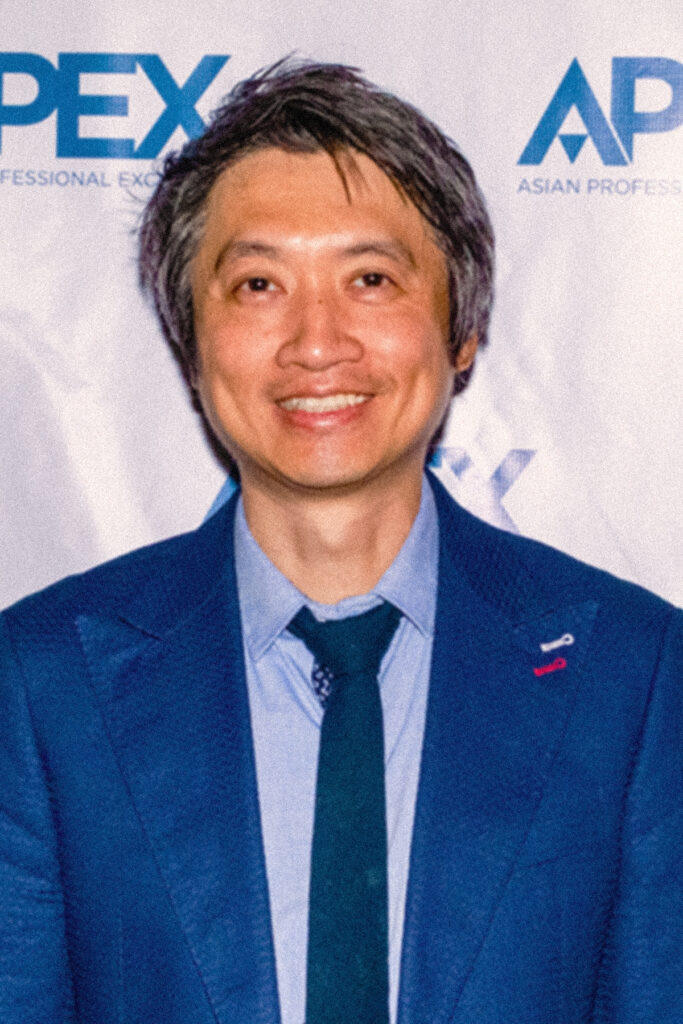
You’re heavily involved in professional programs, such as your role at APEX. What do you hope young Asian and Asian-American filmmakers learn from your journey?
I came from a family that fits quite well into the Asian stereotype where the parents want their child to become a professional (doctor, lawyer, etc) and my parents were at first definitely not thrilled by my decision to quit law and go into filmmaking, but with time comes greater mutual understanding, and they have come to respect my decision despite all the conventional societal pressure – whether real or imaginary – put on the family. I guess it also helps that I can show and prove to them that my work is meaningful and valuable, even though it is vastly different from practicing law. And so I hope my story can inspire fellow Asian filmmakers with similar family dynamics to follow their dreams. It’s not really as scary as we have been taught to believe.
What excites you most about your upcoming editing workshop—and what’s the one lesson you hope every participant walks away with?
It’s been a while since I sat in a room of aspiring filmmakers to share lessons I have learned in filmmaking and editing, so I’m quite excited about this upcoming workshop I’m hosting with APEX. There will be a couple of technical demonstrations and I hope every participant can have fun and walk away inspired to work on their own projects.
Can you tell us about your upcoming projects, particularly the true crime documentary and the documentary on the Ukraine War you are producing? How do these projects continue your mission of boundary-breaking storytelling?
The true crime documentary revolves around a covert drug trafficking operation led by former US soldiers that imploded with a triple-homicide. It explores national issues such as veteran’s mental health, organized crime, and law enforcement accountability. Meanwhile, the documentary I’m producing on the Ukraine War focuses on the lives of the residents of one specific Ukrainian town. While these are completely different subject matters, they both feature multi-faceted characters in crises and whose struggles audiences will find relatable. My job in both projects is to find the right angles and focus on universal human qualities that transcend things like borders and culture.
What has been your proudest moment so far—not in terms of awards, but in terms of personal fulfillment or audience impact?
I am really proud of the work I did for the documentary “2020: Chaos and Hope,” not just because it really put my technical knowledge to the test, but also because I got to work with not one, but two, Emmy winner/nominee on a project that is socially relevant and which I feel morally and politically aligned with. It is not every day one gets to work on a project like that.
If you could speak directly to your younger self, just as you were leaving law to pursue filmmaking, what would you say?
“Don’t be afraid to say no” – that’s what I would tell my younger self. Especially when it comes to turning down the more lucrative jobs that may not align with your artist aspirations. It’s easy to forget the fact that when you allow yourself to be occupied by busy work, you are also forgoing the opportunity to work on more interesting and rewarding projects.
Official website of Marcus Chan: