• Home
  • Interviews
  • Reviews
  • About
  • Print
  • Contact

Indie Cinema Magazine

Menu
  • Home
  • Interviews
  • Reviews
  • About
  • Print
  • Contact
Home › Personalities › Reviews › Theater › Just Call Me God: A dictator’s final speech Review

Just Call Me God: A dictator’s final speech Review

by Diana Ringo


March 14, 2017
   

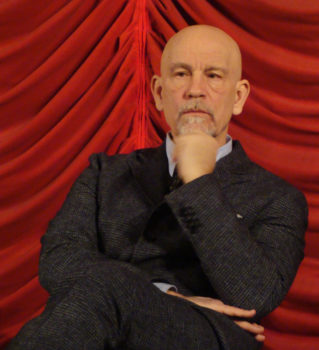
John Malkovich © Elena Ringo

John Malkovich © Elena Ringo

Just Call Me God – John Malkovich is a dictator in a darkly funny stage play.

Just Call Me God: A dictator’s final speech is the third stage play with Hollywood star John Malkovich (Dangerous Liaisons, Being John Malkovich) and Austrian director Michael Sturminger. Their previous collaborations were “The Infernal Comedy” and  “The Giacomo Variations”, which was also adapted to a film starring Malkovich by Sturminger. Just Call Me God premiered at the Elbphilharmonie in Hamburg and was performed in Vienna on the 12th and the 13th of March. It will be later staged in the UK, Moscow, Budapest and in many other countries.

In the Third-World country of Circassia, armed American soldiers shuffle about underground in the dark, armed with flashlights and assault guns as they search for the eccentric dictator Satur Diman Cha who has terrorized the country for decades.

As the troopers look around, they discover that they are in the Ar-Kasaba Palace Concert Hall – a replica of the Vienna Konzerthaus (in other countries different concert halls are mentioned) which the dictator has built many meters below the desert. There is also a joke when they mix up the Konzerthaus with the Musikverein twice. During their inspection they only find banners, a lectern and an organ. Among the soldiers is Caroline Thomas, a journalist of the TV station NCC (Sophie von Kessel) and a military chaplain, reverend Lee Dunklewood (Martin Haselböck).

Then they receive a radio transmission informing them that Satur Diman Cha was found in a suburb and killed. The soldiers breathe easy and request the reverend to test out the organ. Dunklewood plays the Ride of the Valkyries by Richard Wagner on the organ and at this moment a woman clad in a headscarf, propelling a cleaning cart, enters the room and shoots almost everyone dead with a machinegun.

The shrouded figure begins to talk in a heavily-accented male voice and takes the disguise off, it turns out to be Satur Diman Cha himself. With a drawn golden pistol he instructs the survived reverend to play the organ; he hands Dunklewood over the score of All Men Must Die by Johann Sebastian Bach and tells him to play on or die right now. Diman Cha nicknames the chaplain as Bach.

Later Diman Cha discovers that the female journalist is still breathing and holds Caroline hostage. He instructs her to tie up the organist with duct tape to the bench. The dictator refers to Caroline as sweetheart and she even manages to take a video interview with him despite him not conversing with the Western press in many years. When Caroline asks how Diman Cha should be addressed in the interview, he says – just call me god. They hold discourse about power and the meaning of evil and throughout the play there is strong tension because the tyrant is clearly capable of killing the reporter and the organist at any moment.

Director Michael Sturminger said that the character of Satur Diman Cha in Just Call Me God was supposed to an amalgamation of many historical figures including Stalin, Pol Pot, Mao Zedong, Saddam Hussein and Muammar al-Gaddafi.

Music featuring the organ combined with additional electronic effects, ranging from classical compositions to Haselböck’s own pieces, was a beneficial addition and set a suitably eerie mood. Malkovich’s voice was also sometimes amplified and distorted in order to portray a man who thinks of himself as almighty.

The organ was chosen because of its association with power, it was a beloved instrument of many rulers and is an intense musical tool because it has the ability to resemble a whole orchestra.

The addition of the two video screens was an interesting idea. As the main characters operate the journalist’s video camera, the two screens show the live output which allows the viewers to see the actors in close-up. Also since the play is in English but intended for an international audience, the subtitles are shown for the non-English speaking viewers.

Just Call Me God is a spirited musical-theater piece full of dark humor. John Malkovich is convincing and magnetic in the role where he must shift between cruelty and gentleness. The sparse staging is fitting for this character driven performance and the ending is not too predictable. The play is a must see for people interested in modern theater and for fans of Malkovich.


 

Personalities Reviews Theater

 Previous Post

Next Post 

Author: Diana Ringo

Related Articles

Jim Carrey on Jimmy Kimmel Live! in 2014

Impostors in the Spotlight?

by Günther Kramer
April 16, 2026

Attack of the Clones—Jim Carrey, Pamela Anderson, and the Illusion We Applaud In March 2026, during the prestigious César Awards

‘Mengele’ Aims for Historical Thrills but Gets Lost in Execution

by Pete Brown
April 5, 2026

Canvas to Camera: The 15 Best Movies About Painters

by Pete Brown
March 25, 2026

Mr. Nobody Against Putin — A Puzzle of Myth, Ambiguity, and the Oscar

by Günther Kramer
March 25, 2026

Sydney Sweeney and Amanda Seyfried Anchor the Tense Mind Games of ‘The Housemaid’

by Pete Brown
March 1, 2026

Solaris 2026 Winners: A Celebration of Independent Cinema in Helsinki

by Günther Kramer
February 8, 2026

Brigitte Bardot: The Eternal Rebel of French Cinema Dies at 91

by Elena Ringo
December 28, 2025

Blood Star: Director Lawrence Jacomelli’s Debut Feature — The 10-Day Desert Shoot That Shouldn’t Have Been Possible

by Günther Kramer
December 10, 2025

Latest News

Impostors in the Spotlight?

by Günther Kramer April 16, 2026 | No Comment

‘Mengele’ Aims for Historical Thrills but Gets Lost in Execution

by Pete Brown April 5, 2026 | No Comment

Canvas to Camera: The 15 Best Movies About Painters

by Pete Brown March 25, 2026 | No Comment

Mr. Nobody Against Putin — A Puzzle of Myth, Ambiguity, and the Oscar

by Günther Kramer March 25, 2026 | No Comment

Sydney Sweeney and Amanda Seyfried Anchor the Tense Mind Games of ‘The Housemaid’

by Pete Brown March 1, 2026 | No Comment

Solaris 2026 Winners: A Celebration of Independent Cinema in Helsinki

by Günther Kramer February 8, 2026 | No Comment

Brigitte Bardot: The Eternal Rebel of French Cinema Dies at 91

by Elena Ringo December 28, 2025 | No Comment

Blood Star: Director Lawrence Jacomelli’s Debut Feature — The 10-Day Desert Shoot That Shouldn’t Have Been Possible

by Günther Kramer December 10, 2025 | No Comment

The Curse of Modigliani (2025) — A Modern Interpretation on the Life of Amedeo Modigliani

by Günther Kramer December 7, 2025 | No Comment

The Haunting of Prince Dom Pedro — A Clever, Campy Indie That Makes History Class a Killer Good Time

by Günther Kramer November 3, 2025 | No Comment

Do Not Be Afraid of Anything: Ronn Moss Speaks from the Heart

by Elena Ringo October 11, 2025 | No Comment

Kristin Griffith and Artur Smolyaninov Win Top Acting Honors at Prague Independent Film Festival

by Günther Kramer September 25, 2025 | No Comment

Filmmaker Marcus Chan Talks Craft, Representation, and Creative Risk

by Diana Ringo July 11, 2025 | No Comment

Forever Breathless: 65 Years of Godard’s À bout de souffle

by Elena Ringo June 7, 2025 | No Comment

Clint Eastwood at 95: The Last Cowboy Still Rides

by Günther Kramer June 3, 2025 | No Comment

Cannes 2025: Loznitsa’s Two Prosecutors Stuns Critics as Jafar Panahi Takes Palme d’Or in Politically Charged Edition

by Günther Kramer May 25, 2025 | No Comment

Concrete Nothingness: How The Brutalist Builds to Nowhere

by Elena Ringo April 29, 2025 | No Comment

Watch the Curse of Modigliani Trailer—Obsession, Betrayal, and a Haunted Diary

by Günther Kramer February 22, 2025 | No Comment

Anora: A Vulgar Ass-ault on Cinema

by Elena Ringo December 21, 2024 | No Comment

A Raven in Tokyo: How Mark Gill Captured the Troubled Genius of Masahisa Fukase

by Diana Ringo November 14, 2024 | No Comment

Megalopolis: A Misstep from a Legendary Director

by Elena Ringo November 12, 2024 | No Comment

Inside the Making of “Saving Mango”: A Cat’s Story of Survival and Loyalty

by Diana Ringo October 27, 2024 | No Comment

Facing the Past: Exploring Generational Trauma in They Don’t Leave

by Diana Ringo October 3, 2024 | No Comment

Indie Cinema Magazine – Issue 7

by Günther Kramer September 22, 2024 | No Comment

Generations and Identity: Inside Ying Chu’s Ah-Ma: A Tale of Two Worlds

by Diana Ringo September 20, 2024 | No Comment

Exploring Love Through Grief: Darrell Bridgers’ Psychological Journey in “Zeke”

by Diana Ringo September 16, 2024 | No Comment

“HOME”: Shimizu K’s Latest Film Examines Family Relationships and the Complexity of Communication

by Diana Ringo September 14, 2024 | No Comment

Kyle Browne and Ken Kinna’s Meditative Film “Spirit Sensing: Anima of the Quarry”

by Diana Ringo September 8, 2024 | No Comment

Interview with film director and animation legend John Musker

by Diana Ringo September 8, 2024 | No Comment

The Untold Influence of Arleen Schloss: Stuart Ginsberg Discusses His Documentary Debut

by Diana Ringo September 5, 2024 | No Comment

The Magazine of Independent Cinema

Copyright © 2026 Indie Cinema Magazine

Social Links

  • Subscribe
  • About
  • Team
  • Contact