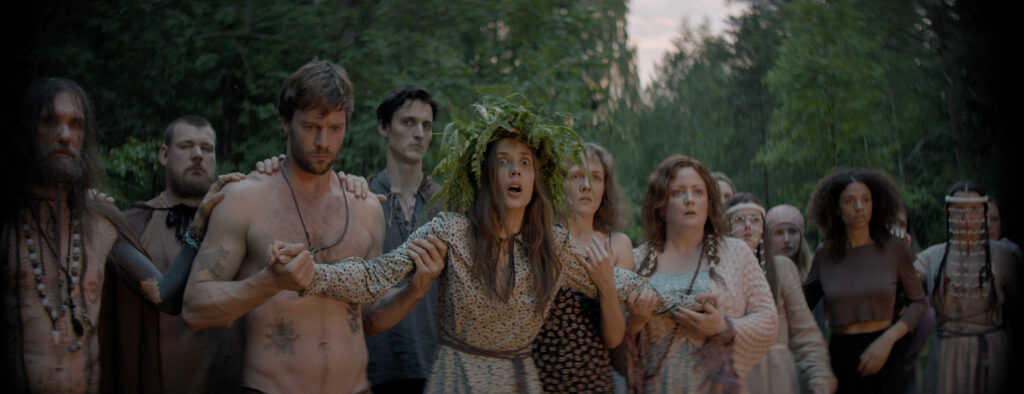
Denis Kryuchkov, the director of “The Whirlpool”, is a Russian filmmaker and artist. His feature directorial debut is the 2020 action film “Russian Raid”. His latest film is “The Whirlpool,” a film blending psychological horror, Russian folklore, and societal themes. This interview delves into his artistic journey and insights into the film. The film received the Grand Prix and Best Actor (Wolfgang Cerny) awards at the Vienna Independent Film Festival in September 2023.
When exactly did Olga Loyanich (producer and screenwriter) get the idea to write a script on this topic and what inspired the creation of the film? The film “The Whirlpool” contains occult rituals and mysticism; what kind of research and preparation did you do in this area to bring authenticity to these scenes?
The idea to write the script for “The Whirlpool” came to Olga a few years ago, based on her experiences visiting various sects, teachers, coaches, shamans, and more. Olga has always been interested in self-discovery and various practices. The script was initially a reflection of her own journey of self-exploration, focusing on the theme of women’s fate and self-discovery. It was written as an exploration from the beginning, allowing viewers to delve into the deepest corners of the heroine’s consciousness. The film aimed to make rituals more authentic by incorporating real Northern ritual singing, a legacy of pre-Christian, Vedic culture, which was passed down orally in northern villages and documented by researchers in the late 19th and early 20th centuries.
The film “The Whirlpool” touches on current social issues, such as domestic violence and the commercialization of spiritual practices. What else would you like to say on this topic?
The theme of domestic violence remains unfortunately relevant and is perpetuated from one generation to another, often normalized within families. “The Whirlpool” seeks to explore the blurred line between violence and non-violence, especially when someone seeks help from a sect or shaman. The film attempts to find that boundary along with the heroine, from primitive domestic violence to a more refined, spiritual form.
Your film has a wonderful cast, including Alyona Mitroshina, Wolfgang Cerny and other talented actors. What qualities did you look for when choosing actors to create complex characters, and what was it like collaborating with them on set?
The film boasts a talented cast, including Alyona Mitroshina and Wolfgang Cerny. The casting process was meticulous, and Alyona Mitroshina stood out as the 23rd actress to audition. She brought the character to life effortlessly. Wolfgang, on the other hand, discovered the script by chance and felt a deep connection to his character. His natural magnetism and soft power made him the perfect fit for the role of the Guru. The collaboration with the actors was productive, creating a close-knit ensemble that contributed to a highly productive atmosphere on set.
“The Whirlpool” raises questions about the unconscious and Nietzsche’s idea that if you gaze long into an abyss, it begins to gaze back into you. How do these philosophical concepts fit into the overall storyline of the film and affect its characters?
In “The Whirlpool”, the film attempts to shed light on the practices of self-discovery, delving into the depths of this process. Like any potent medicine, such practices can be both poison and panacea. When a person realizes that they are hiding something from themselves deep within their psyche, something likely painful, they turn to self-discovery practices, seeking help from specialists, be it psychologists, shamans, cults, or trendy coaches. When a person confronts their innermost self as a result of their efforts, it’s always a challenging, shocking moment to endure. The personality of the person alongside you during this revelation plays a crucial role. The influence is mutual; the shaman, too, may be unprepared for the depths revealed by their patient. We only scratch the surface of a theme that requires much deeper exploration.
Tell us about working with cameraman Hayk Kirakosyan. Could you share any interesting stories about the filming process? Were there any unexpected moments that required unusual solutions?
Working with cinematographer Hayk Kirakosyan was a stroke of luck for the entire production team. He learned to shoot on black-and-white film at VGIK and later became one of Turkey’s most recognized cinematographers. He is someone who knows everything about filmmaking, especially in the era of technological progress. For me and the whole team, it was like attending a masterclass in world cinema. Can you imagine when a seasoned cinematographer and his crew arrive on set and start running? The lighting crew’s faces initially stretched in disbelief, but they soon adapted and started running too. How else could we shoot a film in the woods, under intense time constraints, with only 20 takes a day? Hayk and I decided that twilight, that moment when everything turns a bit purple and the air feels denser, was the best time for creating a sense of mystique. However, twilight only lasts an hour a day, and creating such lighting artificially is usually reserved for big studios and likely indoors. We had an independent budget (albeit small), but the beauty of the Russian North with its dense forests was all around us. Hayk said, “I believe in us; we are ready; we will capture it.” We rehearsed each shot many times as a group, waiting for the right light, and then we filmed at an incredible speed. It was a test for both me and the producers when Hayk would say, “We’re waiting; the light hasn’t come yet,” while time was ticking away. But when I saw the footage on the big screen, it was a reward for our efforts – he truly managed to capture that indescribable light, a rare phenomenon for the big screen.
What influences, besides Russian folk symbolism, influenced the style and aesthetics of your film “The Whirlpool”?
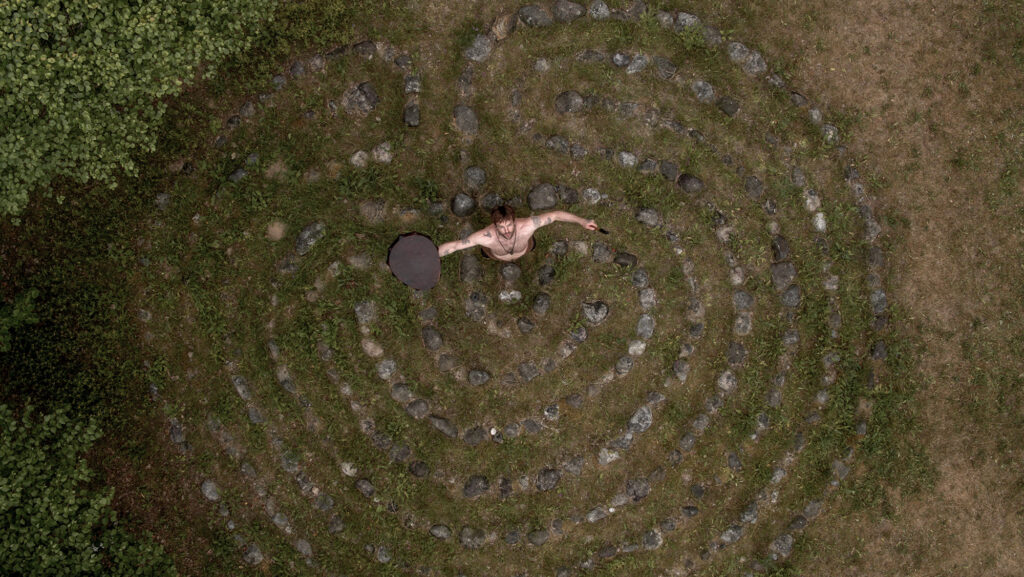
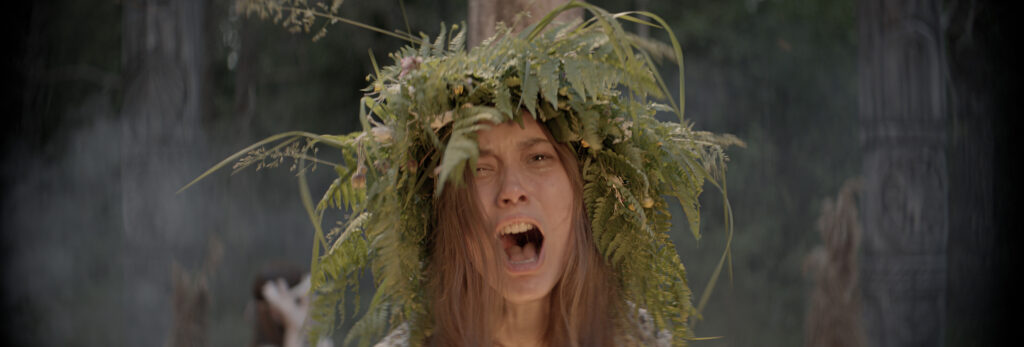
There were numerous influences on the style and aesthetics of our film “The Whirlpool,” beyond Russian folklore symbolism. I’ve been deeply involved in contemporary art, which actively explores tools of self-discovery, sects, shamanic practices. I believe that the concept of an artist emerged from the shaman’s persona, who eventually split into a priest and an artist. In 2009, I directed Monteverdi’s opera “Vespro della Beata Vergine” in Paris as a stage designer. The director was the artist Oleg Kulik, who also had a significant influence on me. It was the 100th anniversary of the Diaghilev Seasons in Paris, at the Châtelet Theater, and we attempted a kind of liturgy, aiming to restore a spiritual function to art. Interestingly, the composer Hermes Hermes Zygott, who created ritual songs for “The Whirlpool”, was also part of our team for “Vespro.” He appears in the film as one of the sect members. For instance, the house where we filmed the movie belongs to the talented St. Petersburg artists Sergey Rokambol and Anna Nikolaeva. We made no changes to it, and its rich texture was built up over many years. Most of the artwork on the walls is theirs, including the constructed labyrinths. They work in the style of magical realism, and we have collaborated on some great projects that have had a significant influence on me. I now refer to the genre I work in as Magical Realism.
Tell us about the choice of musical score for the film. What role did music play in creating the atmosphere of “The Whirlpool”? How did you find the composer Andrey Kliminov?
Unfortunately, composer Andrey Kliminov only joined during post-production as we struggled to find a musical counterpart for the ritualistic music, which was quite unconventional for a broader audience. Initially, I contemplated making the film exclusively with folklore music, but it became too heavy. We reached an impasse, and that’s when Andrey proposed linking the film with very romantic music, the theme of the main heroine. I thought it might be dissonant, but when I saw and heard it on screen, I realized that his music expanded the film’s boundaries and enhanced the heroine. He composed truly beautiful music, which serves as a counterpoint in some places and blends harmoniously with the rituals in others, creating a metamorphosis that occurs within the heroine.
“The Whirlpool” raises numerous philosophical and social questions. In your opinion, what discussions and debates could they lead to in contemporary society?
We aren’t opening entirely new dialogues; our goal is to draw a broader audience into these discussions and encourage them to examine the problem from new angles, delving deeper into the motivations of all participants. We aimed to create a therapeutic film, one that helps viewers see and discuss their own issues. The audience embarks on this journey alongside the heroine and receives hints on how they could navigate it themselves. You could say it’s experimental cinema.
Initially, you received your education as an artist. Could you tell us when and how you decided to venture into filmmaking?
Yes, I graduated from the Stroganov Moscow State Academy of Arts and Industry, and my background as a graphic artist has been extremely helpful, especially in creating storyboards—I always draw them myself. I’ve always been drawn to filmmaking. In the early 2000s, I started directing music videos for underground rap artists like Nogano, Basta, Guf, and others. I experimented with documentary filmmaking and video art. I directed my first feature film in 2006, which was a film-poem titled “Rvy” based on Oleg Gruz’s poem. The film featured two patients in a mental institution conversing in verse for over an hour, quite an unconventional spectacle. I’ve conducted numerous experiments in filmmaking, and if you’re interested, you can check out many of them on my website. It doesn’t have everything, but it showcases a substantial body of work.
Which films, directors, or cinematic works have had the greatest influence on your own creativity and style?
I grew up in Ryazan, and while studying at the art school there, Andrei Tarkovsky was like our bible. I know all of his films by heart. In 1988 or 1989, I saw Alan Parker’s film “Angel Heart,” which also made a profound impact, but in a different way. Back then, it was quite challenging to access good cinema, so I discovered filmmakers like Bernardo Bertolucci and Robert Bresson later. They formed the foundation for my creative journey. The walls of my cinematic influences include Terry Gilliam, David Fincher, Alejandro González Iñárritu – for example, I watched “Birdman” two or three times as if it were a textbook for directors. And of course, “Fight Club” has influenced all of us.
What advice can you offer to aspiring young directors?
Find something you know and are deeply passionate about. When you find it, don’t rush straight to the camera. Prepare for the shoot extensively. The preparation for a film is the real work of a director. On set, you see the results, and there’s often very little you can change.