In a horror landscape oversaturated with self-serious franchises and disposable teen slashers, The Haunting of Prince Dom Pedro arrives as a spirited antidote — a knowingly ridiculous spoof that treats camp as an art form. Directed by Don Swanson and written by Joe Fishel (who also stars), this supernatural comedy isn’t just entertaining — it feels like discovering a future cult classic in real time.
What if your high school history class came back to literally haunt you? That’s the bizarre but oddly compelling premise behind The Haunting of Prince Dom Pedro, an indie supernatural comedy that gleefully mashes up haunted house tropes, teen slasher parody, historical satire, musical numbers, and even Bigfoot into one sprawling fever dream. The film confidently asks: Why pick one genre when you can throw them all into a blender and see what happens?
Before the story even begins, audiences are treated to three fake trailers — a Bigfoot horror, a gambling thriller, and a dating-app cautionary tale — so convincingly crafted they work as miniature short films. This playful prelude immediately establishes a cinematic universe where nothing is too meta and everything is fair game for a punchline. Even the movie’s full, absurdly long title (“Prince Dom Pedro de Alcântara Francisco António João Carlos Xavier de Paula Miguel Rafael Joaquim José Gonzaga Pascoal Cipriano Serafim”) becomes part of the joke.
The main plot centers on four chronically apathetic students at the unfortunately named Mors High: Jayden, Kayden, Hayden, and Payden. Yes, every name ends in “-ayden.” As if their names weren’t punishment enough, Latin American History means absolutely nothing to them; their exasperated teacher, Mr. D’Ath (played by Christopher Kai), begs them to care about Brazil’s liberator, Dom Pedro I. But the teens would rather scroll through social media than learn anything about the past, and their willful ignorance accidentally awakens a vengeful ghost — Prince Dom Pedro, tired of being forgotten, decides to teach them a very hands-on lesson.
Cue cursed history tests, haunted smartphones, spectral whispers in Portuguese — the film doesn’t just spoof horror — it spoofs everything, it’s a gleeful patchwork of teen-movie absurdity and historical fantasy, filled with enough winks, groans, and sight gags to fuel a midnight screening audience for years to come.
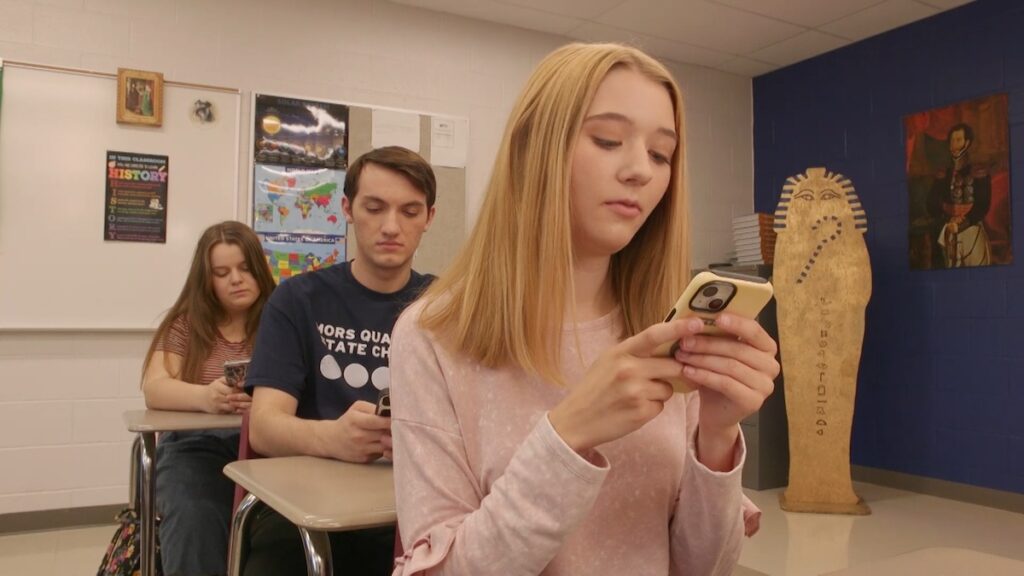
What makes the comedy work is the sincerity of the performances. Madeline Sclichter gives the film an unexpected emotional anchor as Kayden, grounding the absurdity with warmth and musical charm. Her live performance adds genuine texture and give the story a surprising heartbeat amid the chaos. Rachel O’Day (Jayden) and Angela Kuzel (Payden) lean into the silliness with infectious energy. Sclichter’s bright, fizzy presence keeps every scene buoyant, while Kuzel’s timing and cheerful cluelessness deliver some of the film’s biggest laughs. Jaden Wesley Brown (Hayden) balances jock swagger with surprising sweetness, making the group unexpectedly endearing — a tricky feat in a movie so steeped in deliberate ridiculousness.
Fishel, meanwhile, goes full chameleon — in addition to playing Señor Clarke, he embodies Dom Pedro’s ghost and even dons the fur of Bigfoot. Each role is delivered with the same deadpan conviction — the kind of total commitment that turns a goofy premise into something almost profound in its absurdity. Fishel understands that the funniest performances come from taking nonsense seriously, and he never winks at the camera. That decision pays off: the film becomes funnier because everyone behaves as if the ghost of Brazil’s first emperor genuinely is haunting a Pennsylvania high school.
Supporting players like Jennifer Lynn Warren, Allen Enlow, Phil Nardozzi, and Kathy A. Bates round out an ensemble that looks like they’re having the time of their lives. Enlow, as the school’s perpetually long-winded principal, delivers some of the film’s most quotable lines. Anthony Babeaux, Jess Uhler, Benjamin Sheeler, and Angela Katherine Baker also make memorable appearances, each fully embracing the movie’s heightened tone.
The script — co-written by Swanson and Fishel — crackles with waggish humor, layered references, and sharp observations about both horror tropes and modern student apathy. Beneath the farce lurks something unexpectedly poignant: a reminder that history, when ignored, has a way of demanding attention.
Swanson’s direction is brisk, assured, and deeply attuned to rhythm — both comedic and musical. Clocking in at a tight 83 minutes, the film somehow packs in multiple fake trailers, a ghost story, a teen satire, and musical interludes without ever dragging. There’s a guiding intelligence behind the chaos, and that’s what makes it work. Even at its most unhinged, The Haunting of Prince Dom Pedro feels purposeful.
Visually, Swanson — who also serves as cinematographer — embraces the film’s indie roots, his crisp, colorful compositions evoke the playfulness of 1980s horror comedies like Sleepaway Camp or Student Bodies. Practical effects, clever lighting, and an old-school sense of mischief give the film a handmade charm. The haunted sequences, though often absurd, are surprisingly well-staged, balancing tension and comedy in equal measure.
Beneath the camp and chaos, the film sneaks in genuine thematic resonance, Dom Pedro’s ghost may be a joke, but his frustration at being forgotten hits on something real — a cultural amnesia that extends far beyond any classroom. Swanson and Fishel never moralize, but their message lands nonetheless: if we don’t remember where we came from, the past might just come back to remind us — sometimes literally.
For all its meta humor and satirical layers, the film never forgets to be fun; the comedic tone remains refreshingly clean and inclusive — a rarity in modern comedies that often rely on crassness and shock value. The jokes here are built on timing, wordplay, and character — more Airplane! than American Pie.
Music proves to be one of the movie’s secret weapons. O’Day’s on-screen performances and the occasional burst of song add an almost theatrical flair. The musical number about Brazilian independence shouldn’t work — and yet, somehow, it’s one of the highlights of the film.
The extended pre-film trailers deserve special mention. What could have been a throwaway gag becomes a running meta-thread that loops back into the main narrative, teasing a shared cinematic universe from Swanson and Fishel’s imagination. It’s the kind of joke that rewards repeat viewings — not just for the humor, but for the sheer audacity of its construction. This is a film made by people who love movies — and love making fun of them — in equal measure.
There’s an infectious DIY energy here — a sense that every scene was made with laughter just off-camera — the spirit that has long defined cult cinema, where resourcefulness, community, and passion matter more than budget. In that way, The Haunting of Prince Dom Pedro feels less like a one-off oddity and more like a celebration of independent filmmaking itself.
The finale ties the madness together with a flourish that’s both satisfyingly absurd and strangely cathartic. Without giving too much away, it manages to close the story while teasing the possibility of more — perhaps in the form of sequels, spinoffs, or additional fake trailers that expand this bizarre little universe. The ending (and the post-credit sequence!) is as delightfully absurd as the rest of the film, yet it leaves viewers surprisingly joyful — an impressive feat for a story featuring both Bigfoot and Brazilian royalty.
For all its gags, genre-blending, and meta-commentary, what lingers is the sense that this movie was made with heart, beneath the parody beats a real affection for storytelling — for history, for humor, and for the underdog spirit of indie cinema. Swanson and Fishel have created something proudly camp yet deeply sincere, which serves as a reminder that the best comedies aren’t always the ones that play it safe — they’re the ones that take a wild swing and dare you to come along for the ride.
The Haunting of Prince Dom Pedro is a cheeky riff on teen horror that’s more charming than chilling — and all the better for it. It’s a proudly campy, self-aware indie that proves history class really can be killer.
If you’re in the mood for a film that will make you laugh and surprise you with its audacity, then The Haunting of Prince Dom Pedro deserves a spot on your watch list.