In filmmaking, the math is never on your side. Vision grows, budgets tighten, and the distance between them becomes the battlefield where most first time filmmakers fall. But for director Lawrence Jacomelli and producer Victoria Taylor, the equation was even harsher. With no external financing, no U.S. production infrastructure, and a shooting schedule shorter than many commercials, the Brighton-based duo flew across the Atlantic and—against all professional logic—shot their debut feature: the desert serial-killer road thriller Blood Star.
A stark contrast to their polished commercial work under Beast Films, this high-stakes, self-funded experiment pushed their company into the realm of independent cinema. Filmed in the vast, unforgiving isolation of the Mojave Desert, Blood Star became a survival mission in itself, complete with police stops, catastrophic car failures, and a relentless 10-day shoot that left no room for error.
This is the story of how Beast Films evolved from crafting cinematic advertising to making a feature film that, by all conventional industry standards, should never have been possible—and how Jacomelli directed a debut feature that defied the limits of time, resources, and probability.
How would you describe Blood Star to someone who hasn’t seen it?
LAWRENCE:
Blood Star is a road-thriller horror — tonally somewhere between The Hitcher, Duel, Death Proof and Wolf Creek.
There’s a familiarity to the world: long empty desert roads, oppressive isolation, classic Americana locations — gas stations, diners, scrapyards. Those genre touchpoints are there, absolutely.
But at its core, the film is about a bully and the young woman who finally stands up to him. That primal dynamic is the spine, and we twist it in ways people don’t expect. Even though the environment feels recognisable, the story keeps shifting beneath you — turns, shocks, moments of dread you don’t see coming. I haven’t met anyone who has correctly guessed what happens next.
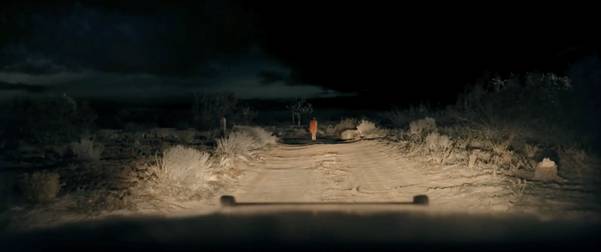
The violence has weight. It’s used sparingly, always with purpose. That grounded tension was important to us. We wanted the audience to feel hunted — and then feel the moment the power finally shifts.
It’s a desert thriller with familiar genre DNA, but a psychological engine that keeps you off balance right to the end.
This film didn’t start like most features. How did Blood Star actually begin?
VICTORIA:
One morning I opened my laptop and wrote something fast, jagged, unfiltered — a woman being hunted across the desert by a predator who strips agency and identity. It wasn’t a treatment. It wasn’t tidy. It was instinct.
LAWRENCE:
When I read it, it didn’t feel like a screenplay. It felt like a rupture. A scream. And once you feel that, you can’t pretend you didn’t. We suddenly found ourselves asking a question we’d never seriously considered:
Could we actually go to America and make this film ourselves?
Nothing suggested we could. But the story demanded it.
The film presents as a road-horror, but you’ve spoken about the deeper psychological core. What was the engine for you?
VICTORIA:
The horror isn’t the violence — it’s erasure. The killer doesn’t just harm.
“He erases. He strips agency. That’s the monster.”
Blood Star is about a woman fighting to reclaim a voice that someone is trying to steal.
LAWRENCE:
Everything — the visuals, the pacing, the geography — came from that idea of silence versus reclamation.
Before Blood Star, how did you decide filmmaking was your path, and what solidified that commitment?
LAWRENCE:
I’ve always been a filmmaker — since childhood. In the 80s I lived behind VHS camcorders, and in the 90s I shot little Super 8 action films, editing everything in-camera. It sounds primitive now, but it taught me the most important lesson: plan everything.
Where does the camera need to go? How do shots connect? What’s the most economical way to tell a visual story?
That discipline — shooting with purpose — is why we managed to film Blood Star in 10 days. Every setup had three angles built into it, maximum two takes. No overshooting. Fast, precise, decisive.
That logic led me into directing commercials, which I loved. A lot of those campaigns worked because they were cinematic and grounded, centred on subtle character behaviour. And working in commercials forces you to communicate well — you’re constantly thrown into new teams, new environments, new problems. You learn quickly that filmmaking is 50% preparation and 50% reaction. Things will go wrong. The only question is how you respond.
But making a feature — the dream — is a different level of commitment. The biggest barrier wasn’t gear or budgets. It was the script. You cannot make a good film from a bad script. Writing something good is hard; writing something good and affordable is almost impossible.
I talked about making a feature for thirty years. At 49, I realised it was time to stop talking and finally do it.
What changed everything was the story itself. Victoria wrote the first draft of Blood Star in one sitting. We had been brainstorming for months, searching for an idea that was exciting but achievable on a micro-budget. When she wrote this sheriff-as-monster concept — the protector as the predator — it clicked instantly. Familiar yet not derivative.
We weighed up the risks:
leaving the kids with grandparents,
putting our own money on the line,
building a film infrastructure in the U.S. from scratch…
It was massive. But the belief outweighed the fear.
What we didn’t expect was the festival response. We honestly didn’t consider festivals at all. Then suddenly we were selected by seven including its world premiere at Neuchatel International film festival and USA premiere at Cinequest Film Festival — sitting in 250-seat theatres watching audiences react with shock, energy, excitement. They came out buzzing. That was the moment we realised it had connected.
So the commitment didn’t come from a career plan — it came from the story demanding to exist.
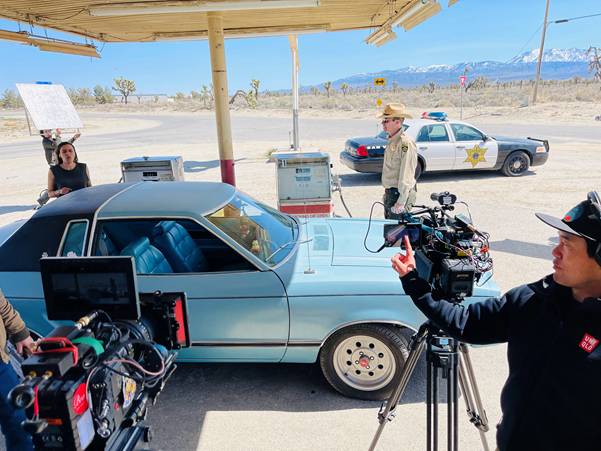
What was the biggest barrier you had to overcome before making your debut feature and why did you think it could be done in 10 days?
LAWRENCE:
The script. Always the script.
I never made a short film over 1 minute — not one — because I never had a script that felt strong enough. I ended up making this bizarre jump from directing 30-second commercials straight to a 90-minute feature.
Another barrier was understanding how to move from “capturing moments” to “crafting dramatic scenes that escalate stakes and build into sequences with arcs and tension.” That’s architecture — and it’s overwhelming at first.
So I did what I always do: I studied. I’ve outlined films for many tears. Hundreds of them. For Blood Star, I leaned heavily on Duel — not because we were copying it, but because its tension and structure became a kind of architectural blueprint.
At one point I told myself:
If you’re going to ask for help, why not ask the best?
So I indirectly asked Steven Spielberg by dissecting his structure, rhythm, escalation. That became my compass.
Around that time, I’d also watched a documentary about Spielberg making Duel in ten days. Ten days. With giant 35mm cameras rigged to moving cars, constantly reloading film mags, working in brutal heat with none of the conveniences we have now. I remember saying to myself:
“If Spielberg could make Duel in ten days in the 70s… surely I can make Blood Star in ten days today.”
That became a kind of mantra.
We then tried to hire First ADs — five of them. And every one said the same thing:
“It can’t be done.”
But we kept refining the script. Cutting scenes, fusing scenes, tightening geography, sharpening transitions — turning it into something mathematically shootable. Eventually we found a veteran AD with enormous experience who looked at the new version and said:
“You might just be able to do this…”
Together we built a plan — a real, working ten-day schedule.
And that was the moment the impossible suddenly felt possible.
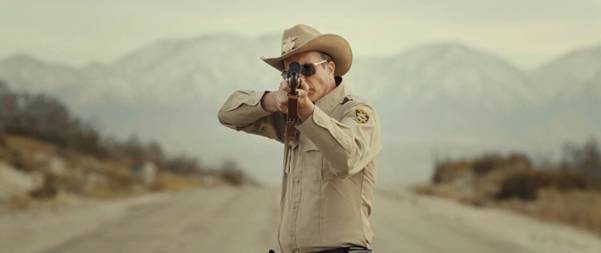
So Spielberg gave you the idea that it could be done – but how did you actually do it?
LAWRENCE:
Very simple: we reverse-engineered the shoot so the geography worked for us, not against us.
First, we found a location where every major setting existed within a one-mile radius. And as for the road sequences — which look like we’re traveling across vast distances — in reality, everything was shot on a single 600–700 meter stretch of road. We would shoot a scene on one side, then move to the other. By changing angles and time of day, we could reuse the same strip again and again without the audience ever catching on. That alone saved us an enormous amount of time.
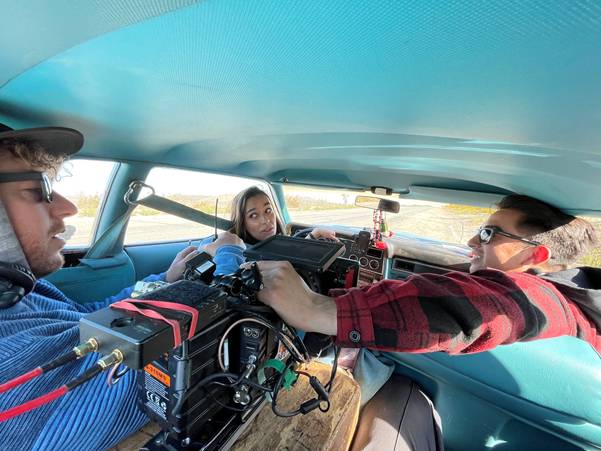
We also spent a huge amount of time in rehearsals. On set, the actors only had two takes per scene, covered with a three-camera setup. There were no third chances — unless something catastrophic happened — and for all the blood and stunt moments, we had one take only. High-pressure filmmaking, but that’s the only way you shoot a feature in ten days.
And remember: every blood effect is a one-time event. If it goes wrong, you’re not just resetting — you’re cleaning costumes, actors, props, the car interior — and we simply didn’t have the time. So it had to work.
Because of this approach, the shoot was fully out of order, and if you look closely you’ll catch little continuity clues: a blood stain on a seatbelt in an earlier scene, or sand and blood on her shoes in the first part of the film. That’s because we shot the night sequences before some of the daylight close-ups.
It was chaotic and fragmented — but it worked. And that’s how we did it in ten days.
You’re based in Brighton. Why shoot a film deep in the Californian desert?
LAWRENCE:
I’m a British filmmaker, yes — but I’ve always been drawn to Americana. In 2011, Victoria and I moved to Los Angeles for two years hoping to make a feature. It didn’t pan out, but visually, the place imprinted itself on us.
America is just cinematic by default.
Low-rise skylines. Palm trees. Vast open roads. Natural production design everywhere you look.
So when Victoria wrote Blood Star, and the desert energy was baked into it, there was no question: my debut feature had to be a desert road movie.
If she had written a hotel-room thriller, we would’ve shot it in the UK. But the combination of concept, cost, and audience potential pushed us toward the desert.
Sometimes you have to just take a leap of faith, trust yourself and those around you.
Who are the artists and filmmakers that shaped your storytelling sensibility?
LAWRENCE JACOMELLI:
My sensibility is rooted in the greats of 70s and 80s cinema — Scorsese, Coppola, Spielberg, Kubrick — and also Hitchcock. There was a time in my 20’s when I watched every Hitchcock film back to back – totally emersed myself and watched nothing else. What I love about him is his precision without preciousness. Spielberg is the same: the camera is never random; it always tells the story.
For me, camera position and movement are everything. They determine what the audience feels long before dialogue does. You can guide emotion purely through lens choice and timing.
Lynch was another huge influence. I practically lived in arthouse cinemas at university. But Eraserhead changed me. I walked out confused, unsettled, moved — and inspired. I watched it again immediately and then wrote my thesis on it.
Lynch taught me that cinema doesn’t need to explain everything.
Hitchcock, Kubrick and Spielberg taught me that it must still guide the audience.
In Blood Star there are moments where I don’t spoon-feed answers, but the clues are there — in the framing, blocking, silence. You have to think. You might even need to watch twice. I love that.
Then there’s Tarantino…
Tarantino is another major influence — he makes films like no one else. He’s his own law, his own genre. He can do anything and does, and I love that craziness wrapped inside a completely commercial capsule.
Blood Star does lean on Tarantino in a subtle way. In Act 3, the film takes on a new direction — the slow, measured dread suddenly gets gnarly and tough to watch. It goes a bit crazy, and I like that. I wanted to make some noise after holding everything so tightly for so long. And we made some very bold choices in that section, choices we thought long and hard about.
If you’ve watched the movie, you know exactly what I mean.
But the point for us was that every creative choice came from theme. Nothing was done just for effect. It all traces back to what we wanted to say, and who we wanted to represent, and with that we allowed ourselves to paint with a lot more colour. Tarantino does that brilliantly — the madness always has a foundation — and that’s something I carried with me into Blood Star.
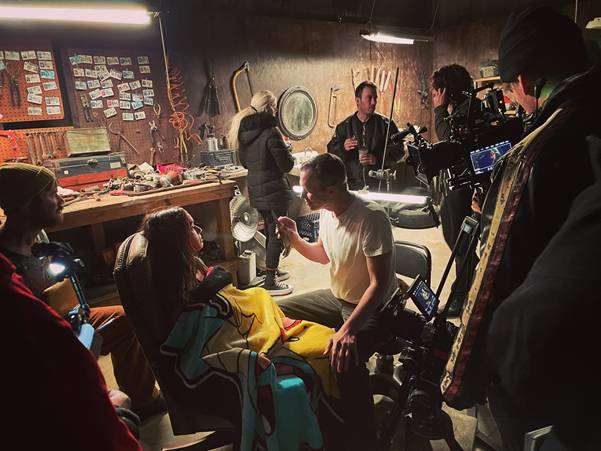
Given the tight schedule, was there any room for improvisation?
LAWRENCE:
On set — none. Zero. The pace didn’t allow it. Ten days, two takes, three cameras rolling — we had to keep moving.
But before the shoot, absolutely. Table reads and rehearsals were where the creative discovery happened. We worked through dialogue line by line, exploring who the characters were and how they behaved.
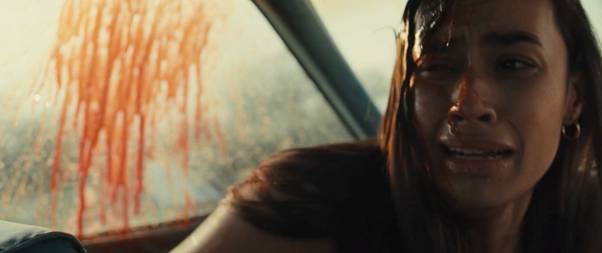
John Schwab — known for The Queen’s Gambit and Jack Ryan — brought enormous craft and subtlety. Britni Camacho, whom we discovered on Instagram without even a reel, brought this raw emotional intelligence. Together they elevated the material hugely.
Another huge factor: I built a full animatic of the film — storyboards, dialogue, temp score, SFX — essentially a rough animated version of the entire movie. That’s the best advice I can give any indie filmmaker. Watching an early version of your film reveals flaws instantly. Scenes that don’t push the story. Repetitions. Pacing misfires.
By the time we entered the desert, the script was locked with precision. The actors weren’t improvising words — they were inhabiting the characters.
What was it like working with John Schwab, and how did he impact the set
LAWRENCE:
Working with John was surreal. With our budget and circumstances, I never imagined we’d land an actor like him. You simply don’t get recognised actors on your first feature unless you have money or a direct connection.
Our connection was Paul Doran — a friend I had approached for help financing the film. Paul knew John and passed me his number. I thought it was a terrible idea. Why would John do our film?
But I called him, pitched the story, and he simply said: “Sure, I’ll read it.”
The next day he’d finished it and drove to Brighton to meet us. That moment changed everything. If someone of John’s calibre says yes purely because he believes in the script, you realise you have something real.
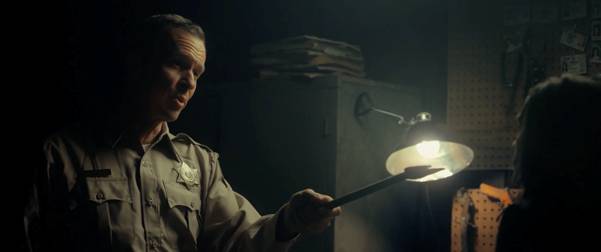
John has a powerful, articulate presence — and he was Sheriff Bilstein from the moment he spoke about the character.
On set he was calm, patient, not method, not performative — just thoroughly focused. When the cameras rolled, he dropped straight into character with total precision. With a two-take system, that level of professionalism was invaluable.
He raised the standard for everyone. And beyond that, he became a genuine friend. Blood Star would not be the film it is without him.
Tell us about the “Mustang miracle” — the disaster that became an upgrade.
LAWRENCE:
Two days before shooting, our hero car — a Nissan ZX300 — blew its transmission during drone tests. Total failure.
We were about to shoot a road movie… without a road-worthy picture car.
There was no backup. Losing that car meant losing the film.
We spent twelve hours driving between lots, cold-calling sellers, chasing dead leads. Everything fell apart. Wrong price, wrong condition, sold an hour earlier… morale just collapsed.
Then at 10 p.m., a listing appeared:
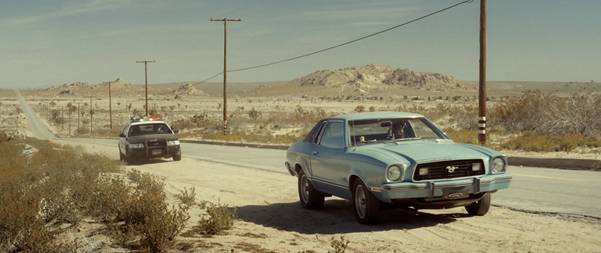
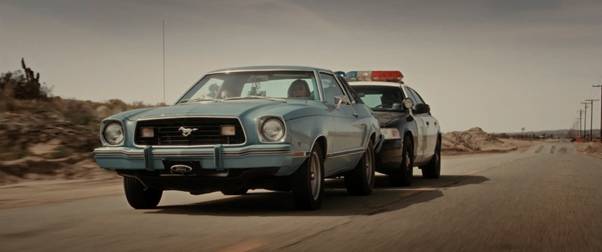
A 1977 Ford Mustang II Ghia, sky-blue, immaculate, $5,000.
We thought it had to be a scam. But it was real — sitting under forecourt lights like a time capsule. We bought it immediately and drove it back in silence.
It didn’t just save the film.
It defined it.
And then the real police stopped your fake police car?
VICTORIA:
Yes — one of those “we’re definitely going to jail” moments.
After wrap, we tried to grab a quick drone shot of our prop police cruiser. The art department — two people stretched to breaking — had forgotten to bag the lightbar or cover the police shield.
We were driving through Palmdale in a “police car” with fake plates. A real police SUV passed us… then the lights went on.
LAWRENCE:
They pulled all three cars over.
“Do you have weapons?”
“License, please.”
My license was with production — they needed it to book a honeywagon. So now I’m a British citizen with no ID, driving a fake police car with illegal plates in a region known for gang activity.
Then I remembered we had a photocopy of the real plate in the glovebox.
They ran the registration — it came back under our line producer, Zaina Tibi, who they knew from the permit office.
Instant mood change.
They let us go with a warning.
We didn’t get the shot… but we kept the car and kept the film alive.
What was post-production like, and how did you shape the final film?
LAWRENCE:
Post-production followed the same energy as the shoot — fast, instinctive, collaborative.
Even after 25 years of directing, I was suddenly working with a brand-new team in almost every department. That included our editor, Ross Evison, who we found on Staff Me Up.
Ross had never cut a feature before, and that hunger is what I looked for. He’d spent years editing film trailers, which meant he had an innate understanding of structure, rhythm, escalation — perfect for a thriller.
He was in New York and I was in Brighton, but that distance was actually helpful. Despite being an editor myself, I believe the edit is the one stage where a director must let go. You need someone else to respond to the footage with fresh eyes.
Ross delivered a stunning first cut. I made changes, of course, but scene after scene, he nailed it.
And then came VFX. People don’t realise how much has to be painted out in the desert: mirrored sunglasses, distant houses, city lights, long empty roads…
Blood Star has 155 VFX shots — more than Oppenheimer.
For the score, our main tonal reference was No Country for Old Men — that slow, inevitable dread. Composer Felix Lindsell-Hales took that idea and expanded it into a full emotional language. His music didn’t just support the film — it defined it.
And we got incredibly lucky with needle drops:
The Bonnevilles and The Mandelbrot Shakes, two bands we’d seen in a tiny Brighton gig. We reached out expecting polite rejection — instead they said, “Why not?”
It gave the film an authenticity we could never have manufactured.
Ultimately, what do you want audiences to feel?
VICTORIA:
Not just fear — recognition. The feeling of a voice being taken… and the fight to reclaim it.
LAWRENCE:
The desert becomes a character — hostile, indifferent. We want the audience to feel hunted, compressed, breathless — and then finally, in the last act, to feel that scream return.
What does Blood Star represent for you both?
LAWRENCE:
A film made without permission. We didn’t wait for a studio, financing, timing, or validation.
VICTORIA:
It represents belief — in the story, in instincts, in each other.
Are you currently working on new projects?
LAWRENCE:
Yes — several. We have multiple thrillers in active financing, all in the same tonal universe as Blood Star: lean, tense, commercially driven, but this time in single locations with more time and resources.
And we’re developing a big-budget sci-fi monster movie — Alien meets The Day After Tomorrow. That’s the one I’d love to make next. It’s ambitious, cinematic, and everything I love about genre filmmaking.
Blood Star and Beast Films — A New Identity
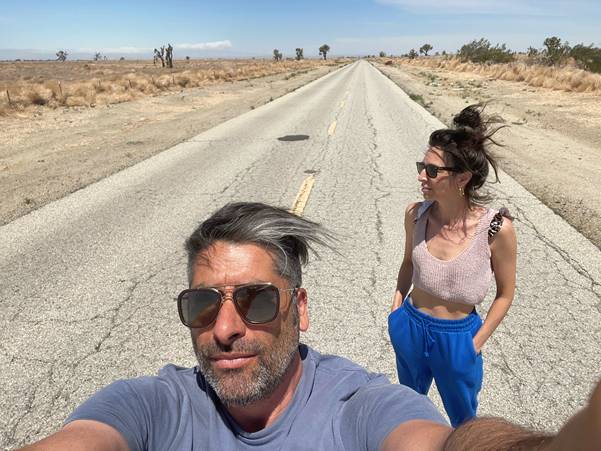
Blood Star ultimately became more than a debut feature — it marked the moment Beast Films stepped beyond its commercial roots and into independent cinema. What began as a spontaneous piece of writing became a defining creative milestone for both Lawrence and Victoria.
They crossed the Atlantic with almost nothing.
They came back with a feature film.
A film born from a scream on the page — answered with everything they had.
Blood Star is available on all streaming platforms in: USA, Canada, UK, Italy, Germany & France
25 Minute Making-Of-Featurette (Contains Spoilers)
@lawrence.jacomelli
@blood_star_movie
@beastvideocontent
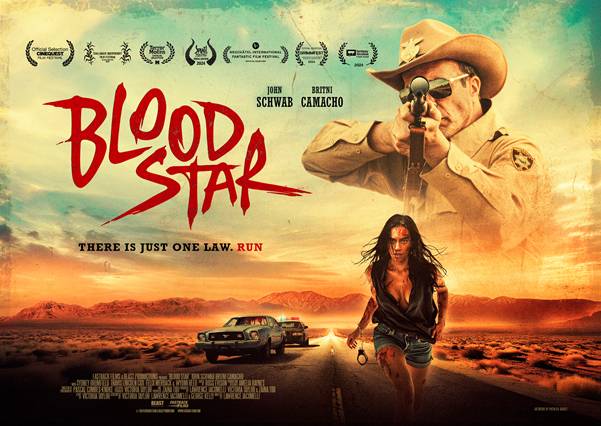
Credits:
BEAST PRODUCTIONS & FASTBACK FILMS
Presents a LAWRENCE JACOMELLI FILM
Starring JOHN SCHWAB BRITNI CAMACHO with SYDNEY BRUMFIELD TRAVIS LINCOLN COX FELIX MERBACK & WYOMI REED Edited By ROSS EVISON Original Score FELIX LINDSELL-HALES Production Designer AMELIA HAYNES Director Of Photography PASCAL COMBES-KNOKE
Executive Producer VICTORIA TAYLOR Producer ZAINA TAIBI
Produced By LAWRENCE JACOMELLI VICTORIA TAYLOR & ZAINA TIBI Story By VICTORIA TAYLOR Screenplay By VICTORIA TAYLOR LAWRENCE JACOMELLI & GEORGE KELLY
Directed By LAWRENCE JACOMELLI