• Home
  • Interviews
  • Reviews
  • About
  • Print
  • Contact

Indie Cinema Magazine

Menu
  • Home
  • Interviews
  • Reviews
  • About
  • Print
  • Contact
Home › Film › Reviews › Sydney Sweeney and Amanda Seyfried Anchor the Tense Mind Games of ‘The Housemaid’

Sydney Sweeney and Amanda Seyfried Anchor the Tense Mind Games of ‘The Housemaid’

by Pete Brown


March 1, 2026
   

The Housemaid (2025)
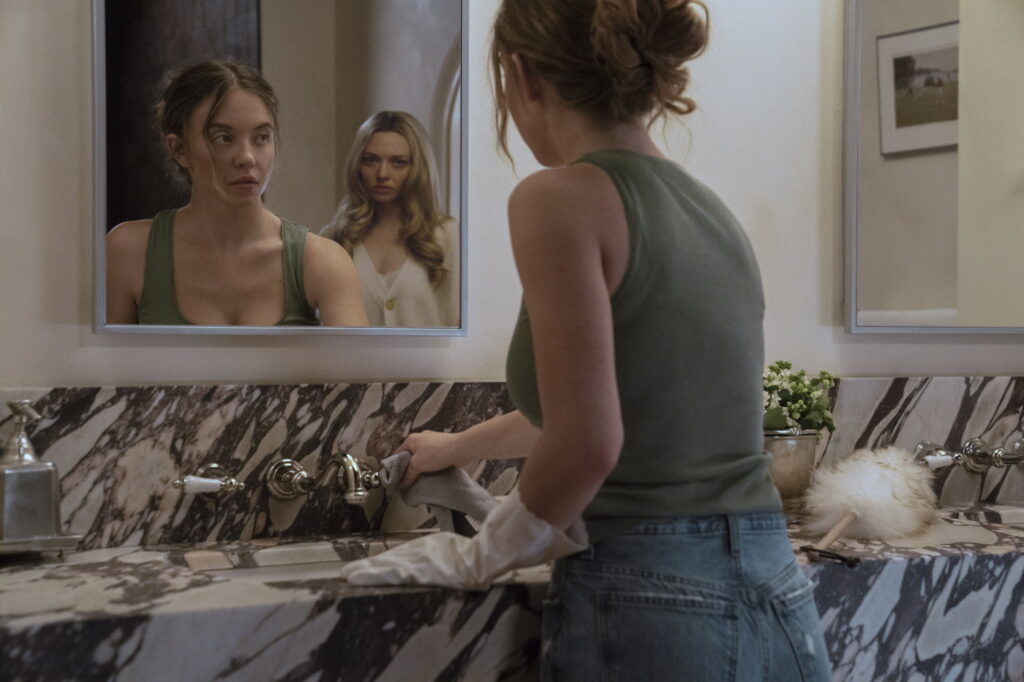
Sydney Sweeney as Millie and Amanda Seyfried as Nina in The Housemaid. Photo Credit: Daniel McFadden/Lionsgate

At the outset, The Housemaid (2025) feels surprisingly modest, perhaps even deceptively simple, for a high-stakes psychological thriller. The initial impression is one of visual restraint that borders on a clinical plainness. Paul Feig’s pivot from the high-energy comedy of Bridesmaids and Spy into the cynical thriller space is a curious move; his background in broad humor may be why he seems less than “at home” with the Hitchcockian visual language that typically fuels such suspense. The cinematography is clean but largely unremarkable, and the lighting—an element so often weaponized in this genre to create a sense of creeping unease—remains curiously flat. For a genre built on the interplay of light and shadow, this approach feels underwhelming at first glance. One expects a stronger stylistic identity—perhaps the claustrophobic framing of a neo-noir or the high-contrast tension of a gothic thriller—to immerse the viewer immediately. Instead, the film presents a world that looks almost too normal, missing the opportunity to use the architecture of the affluent Winchester estate as a source of dread.

However, as the first act concludes, the film takes a different path, and with time, that path becomes increasingly compelling. What initially feels like a lack of visual ambition reveals itself to be a deliberate, if perhaps overly safe, backdrop for a powerfully character-driven narrative that has clearly resonated with audiences, banking over $300 million worldwide. The true strength of The Housemaid lies in its DNA, rooted in Freida McFadden’s bestselling novel and sharpened by a taut script from Rebecca Sonnenshine. What begins as a predictable “stranger in the house” trope gradually deepens into a layered and psychologically engaging game of cat-and-mouse. The pacing is deliberate and it rewards the viewer’s patience by slowly peeling back the domestic veneer of its central trio, starting with Millie Calloway. Played by Sydney Sweeney, Millie is a woman on parole for a crime that lingers in the background, desperate for the stability of a live-in position that doesn’t require a rigorous background check.

The film’s success rests almost entirely on the shoulders of its three leads, and the casting proves to be an absolute coup. Sydney Sweeney manages to navigate the “innocent outsider” archetype with a simmering intensity, playing Millie with a controlled vulnerability that keeps the audience questioning her true agency. Opposite her, Amanda Seyfried provides a perfect foil as Nina Winchester. Seyfried captures the erratic nature of a woman trapped in her own gilded cage, making her both sympathetic and deeply unsettling. The fact that the two actresses share a similar look is entirely intentional, heightening the voyeuristic tension as the power balance shifts. Between them stands Brandon Sklenar as Andrew Winchester, the “sexy husband.” While his character does not dominate every frame, he serves as the essential structural anchor—the pivot point around which the two women revolve. His restraint is effective, embodying the “perfect” husband whose very presence heightens the film’s underlying instability. He leaves the viewer wondering if he is truly a saint or just a very polished facade.

As the narrative deepens, the film introduces a gallery of suspicious supporting players that enrich the mystery. We are forced to wonder why the groundskeeper, Enzo, played by Michele Morrone, is constantly mooching around the French windows, or why Andrew’s mother (who unnervingly resembles Maye Musk), portrayed with a chilling coldness by Elizabeth Perkins, seems to despise everyone but her son. Even Millie’s parole officer begins to feel “shifty,” asking pointed questions that suggest no one in this world is truly beyond reproach. By opting for a neutral visual style, Feig leaves the heavy lifting to the actors, though the script eventually punctuates this normalcy with visceral moments of violence, including a particularly gnarly amateur dentistry scene.

By the final act, the initial aesthetic gripes become secondary to the “emotional roller-coaster” the characters describe. The story tightens like a vise, the emotional stakes skyrocket, and the viewer finds themselves fully submerged in a psychological mire that includes everything from romantic tension to shocking revelations. The suspense emerges not from grand spectacles, but from the organic collision of three complex people with substantial secrets to hide. Once the film leads us to Nina’s strange, triangular attic room, the resolution arrives with a satisfying sense of justice. In the end, The Housemaid leaves a lasting impression—it may not be a visually groundbreaking entry into the genre, but it succeeds through the sheer force of its performances and its meticulously crafted plot.


Film Reviews

 Previous Post

Next Post 

Author: Pete Brown

Related Articles

Jim Carrey on Jimmy Kimmel Live! in 2014

Impostors in the Spotlight?

by Günther Kramer
April 16, 2026

Attack of the Clones—Jim Carrey, Pamela Anderson, and the Illusion We Applaud In March 2026, during the prestigious César Awards

‘Mengele’ Aims for Historical Thrills but Gets Lost in Execution

by Pete Brown
April 5, 2026

Canvas to Camera: The 15 Best Movies About Painters

by Pete Brown
March 25, 2026

Mr. Nobody Against Putin — A Puzzle of Myth, Ambiguity, and the Oscar

by Günther Kramer
March 25, 2026

Solaris 2026 Winners: A Celebration of Independent Cinema in Helsinki

by Günther Kramer
February 8, 2026

Brigitte Bardot: The Eternal Rebel of French Cinema Dies at 91

by Elena Ringo
December 28, 2025

Blood Star: Director Lawrence Jacomelli’s Debut Feature — The 10-Day Desert Shoot That Shouldn’t Have Been Possible

by Günther Kramer
December 10, 2025

The Curse of Modigliani (2025) — A Modern Interpretation on the Life of Amedeo Modigliani

by Günther Kramer
December 7, 2025

Latest News

Impostors in the Spotlight?

by Günther Kramer April 16, 2026 | No Comment

‘Mengele’ Aims for Historical Thrills but Gets Lost in Execution

by Pete Brown April 5, 2026 | No Comment

Canvas to Camera: The 15 Best Movies About Painters

by Pete Brown March 25, 2026 | No Comment

Mr. Nobody Against Putin — A Puzzle of Myth, Ambiguity, and the Oscar

by Günther Kramer March 25, 2026 | No Comment

Sydney Sweeney and Amanda Seyfried Anchor the Tense Mind Games of ‘The Housemaid’

by Pete Brown March 1, 2026 | No Comment

Solaris 2026 Winners: A Celebration of Independent Cinema in Helsinki

by Günther Kramer February 8, 2026 | No Comment

Brigitte Bardot: The Eternal Rebel of French Cinema Dies at 91

by Elena Ringo December 28, 2025 | No Comment

Blood Star: Director Lawrence Jacomelli’s Debut Feature — The 10-Day Desert Shoot That Shouldn’t Have Been Possible

by Günther Kramer December 10, 2025 | No Comment

The Curse of Modigliani (2025) — A Modern Interpretation on the Life of Amedeo Modigliani

by Günther Kramer December 7, 2025 | No Comment

The Haunting of Prince Dom Pedro — A Clever, Campy Indie That Makes History Class a Killer Good Time

by Günther Kramer November 3, 2025 | No Comment

Do Not Be Afraid of Anything: Ronn Moss Speaks from the Heart

by Elena Ringo October 11, 2025 | No Comment

Kristin Griffith and Artur Smolyaninov Win Top Acting Honors at Prague Independent Film Festival

by Günther Kramer September 25, 2025 | No Comment

Filmmaker Marcus Chan Talks Craft, Representation, and Creative Risk

by Diana Ringo July 11, 2025 | No Comment

Forever Breathless: 65 Years of Godard’s À bout de souffle

by Elena Ringo June 7, 2025 | No Comment

Clint Eastwood at 95: The Last Cowboy Still Rides

by Günther Kramer June 3, 2025 | No Comment

Cannes 2025: Loznitsa’s Two Prosecutors Stuns Critics as Jafar Panahi Takes Palme d’Or in Politically Charged Edition

by Günther Kramer May 25, 2025 | No Comment

Concrete Nothingness: How The Brutalist Builds to Nowhere

by Elena Ringo April 29, 2025 | No Comment

Watch the Curse of Modigliani Trailer—Obsession, Betrayal, and a Haunted Diary

by Günther Kramer February 22, 2025 | No Comment

Anora: A Vulgar Ass-ault on Cinema

by Elena Ringo December 21, 2024 | No Comment

A Raven in Tokyo: How Mark Gill Captured the Troubled Genius of Masahisa Fukase

by Diana Ringo November 14, 2024 | No Comment

Megalopolis: A Misstep from a Legendary Director

by Elena Ringo November 12, 2024 | No Comment

Inside the Making of “Saving Mango”: A Cat’s Story of Survival and Loyalty

by Diana Ringo October 27, 2024 | No Comment

Facing the Past: Exploring Generational Trauma in They Don’t Leave

by Diana Ringo October 3, 2024 | No Comment

Indie Cinema Magazine – Issue 7

by Günther Kramer September 22, 2024 | No Comment

Generations and Identity: Inside Ying Chu’s Ah-Ma: A Tale of Two Worlds

by Diana Ringo September 20, 2024 | No Comment

Exploring Love Through Grief: Darrell Bridgers’ Psychological Journey in “Zeke”

by Diana Ringo September 16, 2024 | No Comment

“HOME”: Shimizu K’s Latest Film Examines Family Relationships and the Complexity of Communication

by Diana Ringo September 14, 2024 | No Comment

Kyle Browne and Ken Kinna’s Meditative Film “Spirit Sensing: Anima of the Quarry”

by Diana Ringo September 8, 2024 | No Comment

Interview with film director and animation legend John Musker

by Diana Ringo September 8, 2024 | No Comment

The Untold Influence of Arleen Schloss: Stuart Ginsberg Discusses His Documentary Debut

by Diana Ringo September 5, 2024 | No Comment

The Magazine of Independent Cinema

Copyright © 2026 Indie Cinema Magazine

Social Links

  • Subscribe
  • About
  • Team
  • Contact