Stylish Imagery Can’t Compensate for Hollow Narrative and Conceptual Weaknesses.
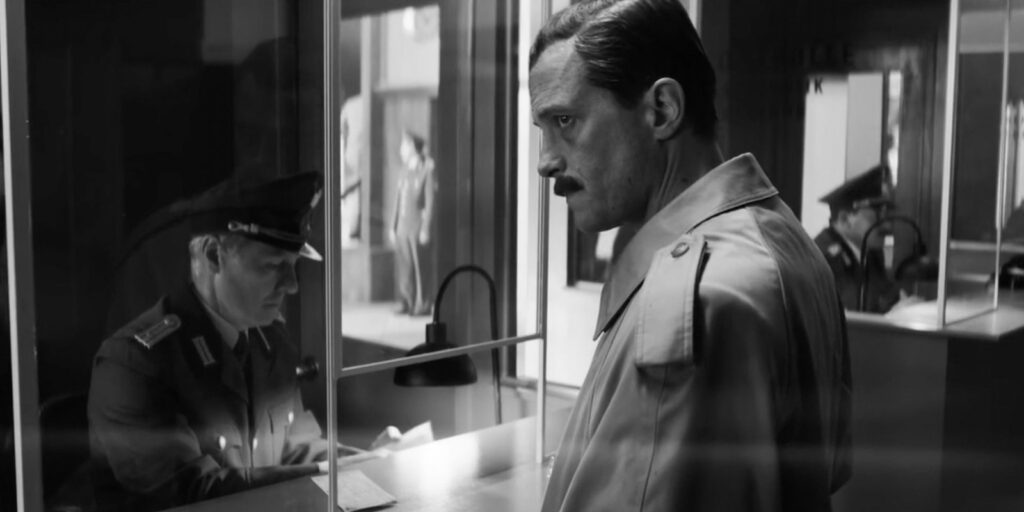
The film “The Disappearance of Doctor Mengele” leaves the impression of being, perhaps, the weakest work by Kirill Serebrennikov to date. Despite its visual ambition and an evident attempt at stylistic expression, the picture feels internally empty and ideologically questionable.
Many viewers have noted the black-and-white cinematography, seeing in it references to the aesthetics of the French New Wave. However, the New Wave was not merely a visual gesture—it was cinema about the human being, about inner conflict, about genuine existential and social problems. In Serebrennikov’s film, by contrast, the black-and-white style functions more as a decorative device, devoid of meaningful substance.
The key problem of the film lies in its treatment of the central figure. Josef Mengele is a historically unambiguous character, a symbol of absolute evil that does not require revision or reinterpretation in a humanistic key. Yet the director appears to strive to present him as an internally conflicted, vulnerable figure. As a result, there is a troubling shift in emphasis.
It is also surprising that the charming, handsome August Diehl was cast as Josef Mengele, one of history’s most notorious embodiments of evil. Diehl, a talented actor known for his intensity and range, gives his all to the role, yet the casting feels fundamentally misaligned. Despite his skill, the performance is consistently undermined by the incongruity between actor and character, making it difficult for the audience to fully sense the sinister weight that Mengele is meant to carry.
“The Disappearance of Doctor Mengele” avoids a direct discussion of Mengele’s crimes in the Holocaust, particularly in Auschwitz, focusing instead on his emigration and everyday postwar existence. Instead of an analysis of evil, the viewer is given a series of scenes in which the protagonist engages in nervous, at times absurd dialogues, including conversations with his son. The staging of these dialogues feels unconvincing: it is difficult to believe that after the Nuremberg Trials, questions about Mengele’s activities could be formulated so naively within his own circle.
The characterization of the protagonist is also perplexing. We see an irritable, nervous man prone to self-justification. His fear of Mossad, his aggression, and his claims that he was “saving lives” all come across as implausible and even absurd.
Certain scenes appear overtly provocative while lacking any meaningful necessity. Early in the film, the viewer is confronted with a naturalistic depiction of a naked Mengele—an episode that adds neither understanding, nor depth, nor artistic value. This raises an inevitable question: why? Why endow such a figure with bodily “ordinariness” if it does not lead to exposure, but rather blurs the boundaries of perception?
The film’s ending also leaves a sense of conceptual weakness. The scene of the protagonist walking into the sea, followed by a strange, almost grotesque “satanic” party with pentagrams and horns, feels more like a stylistic gesture for its own sake than a meaningful statement. Instead of resolution, the viewer is left with symbolic chaos that clarifies neither the fate of the character nor the author’s position.
Ultimately, the film is not an exploration of evil, nor an attempt to comprehend it, but rather an aestheticized reconstruction of a figure that does not require aestheticization. The attempt to “humanize” Josef Mengele comes across as an attempt to relativize absolute evil from a “nothing is entirely clear-cut” perspective.
The film deliberately focuses on the domestic, psychological, almost intimate existence of Mengele in exile. We see his fears, irritability, paranoia, and his anxiety about being captured by Mossad.
Had the director incorporated even a hint of the complex postwar intelligence games—whether real operations like Operation Paperclip or even hypotheses about Mengele potentially finding refuge in America—the story would have gained an additional dimension. Some proponents of such theories argue that after World War II, Mengele may have had indirect connections with the CIA. It is known that during the Cold War, the United States did recruit certain former Nazi specialists, particularly scientists and engineers, under programs like Operation Paperclip.
Against this background, a question arises: if the U.S. made use of Nazi personnel, could it have also “turned a blind eye” to Mengele? Declassified archives indicate that the CIA was aware of his possible whereabouts but did not take active steps—possibly due to broader geopolitical considerations.
If Serebrennikov had engaged with these issues, the figure of Mengele might have become part of a larger system—one in which evil does not disappear but is redistributed and integrated into new structures of power. But the film does not do this. It seems to deliberately isolate Mengele from global history, leaving him in a vacuum of personal anguish.
This creates a paradox: we are presented with a man who symbolizes one of the most horrific crimes of the 20th century, yet his fate is depicted as if it had no direct connection to the real political mechanisms of the postwar world.
Moreover, ignoring such interpretations—even at the level of artistic suggestion—intensifies the sense of superficiality. The very subject of Mengele’s disappearance is historically surrounded by ambiguity and alternative theories. This uncertainty could have transformed the “The Disappearance of Doctor Mengele” into a multilayered exploration—not only of a criminal personality but also of how different systems—state, intelligence, ideological—interact with such evil.
Instead, the film remains within the limits of a psychological sketch that at times even appears naive. Conversations with his son, fears of capture, bursts of irritability—none of this forms a convincing historical portrait. In the absence of a broader context, the picture loses its scale.
The result is an impression that the director consciously avoided complex and uncomfortable questions—perhaps to focus on the “human dimension.” But in the case of a figure like Josef Mengele, such an approach feels not like deepening, but like simplification.
Serebrennikov no longer appears as an “independent artist,” but rather as part of the international cultural establishment. His films may appear critical, yet in practice they align closely with the expectations and frameworks of the financial elite.
In the case of Josef Mengele, this is especially evident: the memory of evil is preserved, but in a safe, aestheticized form—without genuine horror or moral impact. One gets the sense that such a presentation unintentionally brings the figure of absolute evil closer to the viewer, making it intimate and almost “human,” smoothing over a boundary that should remain insurmountable.
For many representatives of the cultural elite, the idea of the dual nature of evil becomes central: evil is viewed not as something entirely alien, but as part of human nature. Within this framework, figures like Mengele are often interpreted through an intimate perspective, which can lead to excessive psychologization and a softening of perception. The result is not an exposure of evil, but its cultural processing—made more palatable for consumption.
Moreover, many contemporary works of art are indeed constructed on a double level. One is obvious, accessible to a broad audience. The other is for the “initiated.”
In the case of Josef Mengele, this can manifest as follows: On the surface—a story of a broken man in exile, dissolving in loneliness and fear. But on a second level—an entirely different interpretation: the successful escape of a “useful villain.” The same story as in the 2025 film “Nuremberg.”—exactly—this final scene reframes the entire film; the Satanic ritual at the end suggests that Mengele’s story is not just about a man in exile or the moral ambiguities of evil, but part of a larger, almost mythic structure of ritualized malevolence. It implies that his life—and perhaps his “escape”—is orchestrated within a symbolic system of hidden, ritualized power.
On one level, it is a story about judgment, an attempt to establish justice and give evil a legal definition.
On another level—a kind of “magic trick,” a disappearance, the vanishing of a useful man.
Rather than serving as closure or psychological insight, the ritual positions the narrative in a metaphysical or allegorical dimension: Mengele is no longer just a historical figure, but a pawn—or even a manifestation—within a cosmic or “satanic” logic. It reinforces the idea of evil as a system that persists beyond human morality, which aligns with the double-layer reading: for the general audience, a story of exile and fear; for those “in the know,” a story about the orchestration of useful evil within hidden powers.