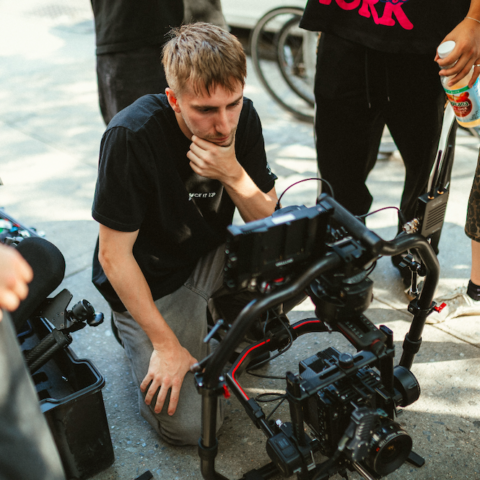
Denis Kryuchkov’s new sci-fi film follows a programmer who enters a deadly virtual-reality game to rescue a woman trapped inside
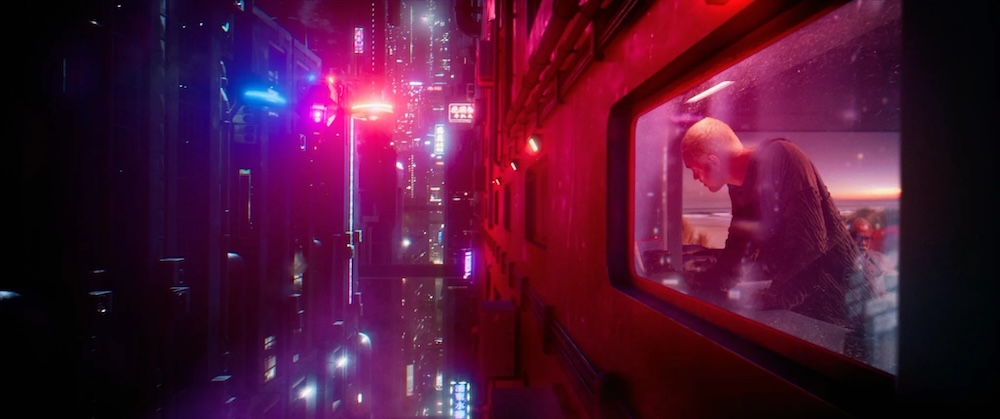
Denis Kryuchkov’s cyberpunk thriller KILL/SAVE arrives today, November 17, 2026, on Apple TV, Prime Video, Google Play, Fandango at Home and DIRECTV.
What happens when the world you trust most is the one you can no longer believe in? That question sits at the center of Denis Kryuchkov’s KILL/SAVE, an ambitious science-fiction action thriller that combines cyberpunk paranoia, virtual-reality suspense and martial-arts spectacle with a surprisingly human story about the lengths one will go to save someone they love.
Set in a quarantined megacity ruled by surveillance and immersive technology, the film follows Martin (Matt Testro), a gifted but solitary programmer who has deliberately distanced himself from the virtual worlds that dominate society. His life takes an unexpected turn when he meets Teresa (Stephanie Gil), a charismatic virtual-reality streamer, and becomes drawn into a mysterious chain of events that challenges everything he believes about technology and human connection. As Martin ventures into an increasingly dangerous digital landscape, the boundaries between virtual and physical reality begin to dissolve, leading him into a surreal world of manipulation, survival and uncertain truths.
KILL/SAVE may draw on familiar cyberpunk anxieties, but it approaches them with a knowing self-awareness, allowing its darker ideas to coexist with humor and an occasional wink at the conventions of the genre. Its concerns, meanwhile, feel increasingly close to home: virtual identities, algorithmic influence, immersive entertainment and artificial intelligence are no longer distant technological fantasies. The filmmakers also draw on gaming culture and the experience of the COVID-19 lockdowns, when billions of people suddenly shifted significant parts of their social lives into digital spaces. The result is a world in which virtual reality is not merely an escape from everyday life but an increasingly seductive alternative to it.
For Kryuchkov, this futuristic setting also provides an opportunity to combine his interest in technology with his background in physical action. The filmmaker, known for Russian Raid (2019) and the mystical thriller Whirlpool (2022), has more than two decades of experience in traditional Chinese martial arts, specifically Liang Baguazhang under Master Li Qimin. Personally overseeing the action sequences, he approached combat like ballet choreography, combining stylized virtual violence with tangible physical consequences.
Kryuchkov and Loyanich point to the works of science-fiction authors Isaac Asimov, Arthur C. Clarke, Philip K. Dick, Stanisław Lem and William Gibson as key literary influences, alongside iconic films such as Star Wars, Alien, Blade Runner and The Matrix, which helped shape the film’s futuristic vision and atmosphere. Drawing on generations of science fiction, KILL/SAVE explores a distinctly contemporary question: what happens when technology becomes so convincing that the choice between reality and simulation is no longer clear? Balancing dark themes and existential questions with playful irreverence and flashes of humor, the film never takes itself too seriously.
Produced by Olga Loyanich, who also co-wrote the screenplay with Denis Kryuchkov, KILL/SAVE brings together an international creative team, with the film’s computer-generated environments developed under the supervision of visual-effects specialist Joel Codina, whose credits include major television productions such as The Mandalorian, The Boys and Star Trek.
Matt Testro stars as Martin and Stephanie Gil as Teresa, supported by Eric Goode, Duane Henry, Joan Pedrola and Bruna Rubio, with Brian Austin Green and Colin Morgan also appearing in supporting roles.
Yet beneath the film’s technological complexity and elaborate virtual environments lies something far more familiar: love. Martin does not enter the world he distrusts because he wants power, wealth or technological enlightenment. He enters it because Teresa is trapped inside. His decision creates the film’s central contradiction: in order to save the person he loves, he must surrender the security and certainty that have defined his life. This emotional premise gives the film’s futuristic landscapes and philosophical questions a distinctly human anchor, ensuring that Martin’s journey remains about more than the technology surrounding him.
This emotional focus is reinforced by the film’s visual approach. Its minimalist physical environments give KILL/SAVE a stark, almost claustrophobic quality, particularly because much of the film unfolds in the single room where Martin is confined. Rather than relying on a constant succession of elaborate set pieces, Kryuchkov takes a more contained approach to science fiction, allowing tension to emerge from Martin’s isolation and the increasingly unstable relationship between his physical surroundings and the virtual worlds he enters.
Through its blend of dystopian science fiction, virtual-reality suspense and martial-arts action, KILL/SAVE examines technology, free will and the meaning of salvation, embodied by the enigmatic AI Eenti and its potentially destructive idea of help. Rather than simply presenting a futuristic playground, Kryuchkov uses this environment to destabilize the audience’s assumptions about reality, control and human agency. Every decision Martin makes carries consequences, while the rules governing his environment remain constantly open to question. Even pain becomes part of the film’s argument: if the body can experience something as real, does it matter whether the world producing that experience is artificial?
The film’s Catalonian locations add another layer to this contrast, placing its futuristic digital environments against tangible physical landscapes. This collision between the real and the manufactured reinforces the uncertainty at the heart of Martin’s journey, as the familiar world outside his virtual experiences becomes just as difficult to trust as the simulations themselves.
Released today, KILL/SAVE arrives at a moment when the questions underlying its story feel increasingly less theoretical. Artificial intelligence is reshaping how people work and communicate, virtual environments are becoming more sophisticated, and digital platforms increasingly mediate how people experience the world. Yet beyond these technological developments, the film returns to a fundamentally human dilemma: how much are we willing to risk for another person, and what are we prepared to sacrifice in the process?
Ultimately, the picture asks a question that reaches beyond its cyberpunk setting and futuristic technology: in a world where almost anything can be simulated, what is worth risking everything to save? And if the virtual world can offer something reality cannot, perhaps the hardest question is not how to escape the illusion — but whether we would actually want to.
Watch KILL/SAVE now on Amazon Prime and Apple TV.