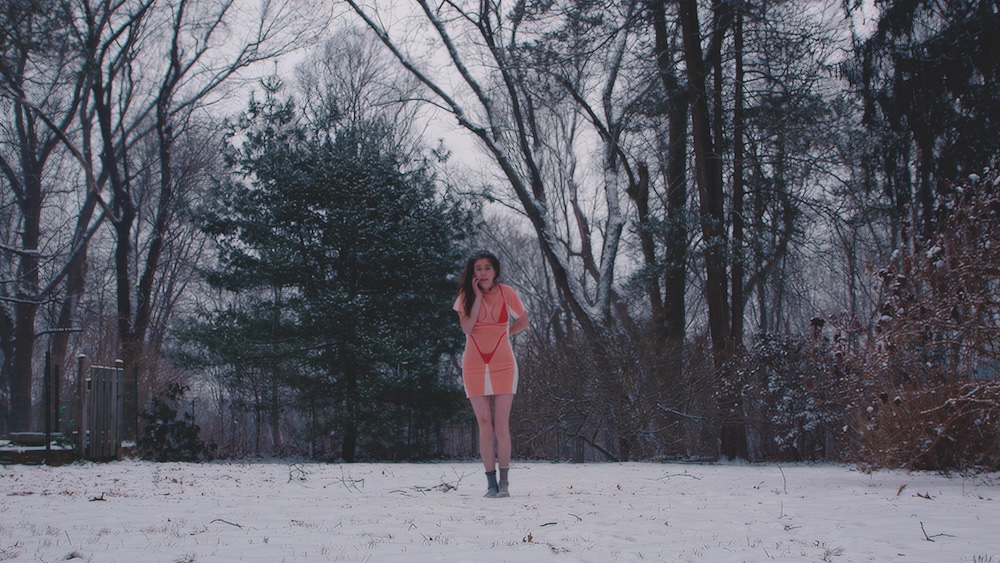
For Claire Titelman, Remember Me began not as a conventional film project but as a creative response to an extraordinarily difficult chapter in her life. The film is set to premiere in Austria at this years Vienna Independent Film Festival. While spending months in her hometown helping her father transition into memory care as he declined with Alzheimer’s, Titelman was also navigating heartbreak, loneliness and the disorienting feeling of having stepped outside her own life. Those experiences became the foundation for the 10-minute short, which Titelman wrote, directed, produced and stars in. She plays a recently dumped 40-year-old woman who has returned home to care for her father and, while preparing for her first date in years, rehearses conversations with an imagined romantic prospect. What unfolds is by turns awkward, funny, sexually frank and deeply moving, as the character grapples not only with the loss of her father’s health and the end of a relationship, but with the more existential realization that confronting someone else’s mortality inevitably forces us to confront our own. Made on a microbudget, Remember Me transforms the constraints of its production into part of its emotional language: its solitary protagonist inhabits a world of absent people, imagined conversations and memories, creating a portrait of grief that is as much about the stubborn desire to reconnect with life as it is about loss. For Titelman, the process of making the film became an unexpected act of healing, turning a period defined by grief and upheaval into something communal, funny and alive.
The film brings together the two strands that have shaped Titelman’s creative life: experimental theater and comedy. At Bard College, she studied playwriting and directing with avant-garde artists Joanne Akalaitis and Chiori Miyagawa, immersing herself in the Theater of the Absurd, while years in comedy—including Chelsea Lately, Parks and Recreationand New Girl—honed her instincts for improvisation and timing. In Remember Me, those influences converge in precisely composed frames and a loose, vulnerable performance, made possible by working with cinematographer Steve Collins as her only crew member. The result is both a film about grief and an emotional time capsule of a life-altering period. In this exclusive interview, Titelman discusses turning grief into comedy, confronting mortality through art and why she believes filmmakers should “tell the story that wants to be told.”
You studied playwriting and directing at Bard College. What did that experience teach you about storytelling that has stayed with you throughout your career?
Bard was very influential for me. I had the privilege of studying with and being mentored by avant-garde director Joanne Akalaitis and playwright Chiori Miyagawa. We studied the Theater of the Absurd—Beckett, Genet, and Ionesco—which embraced form, stylization, the surreal, and the absurd in storytelling. I think you can see that influence in my filmmaking.
Directing theater taught me to think carefully about composition: where bodies are in relation to one another, how they interact with the architecture around them, and how, through that, to create a compelling stage picture. This was especially useful since the film was micro-budget. I didn’t have bells and whistles to rely on to make an interesting shot—just the composition within the frame.
You’ve appeared on famous TV shows including Parks and Recreation and New Girl. What did working on those sets teach you about comedy?
Working on the comedy panel show Chelsea Lately was the best job and taught me a lot about working fast and under pressure. You’d get the topics in the morning and have maybe an hour to write a ton of jokes. Then, in the makeup chair, you’d read them to the producer, who would choose the best ones, and then off you’d go to sit on the panel in front of a live audience. The jokes weren’t honed—you had just written them. There was something thrilling about getting that immediate response from a live audience. It taught me to work quickly, focus, and trust my instincts.
I think that was really helpful when I improvise on film, too. You learn that you don’t always need to rehearse or work everything out beforehand. Sometimes you can just trust yourself and go. There’s magic in that.
When I first met Chelsea Handler, she said, “You’re weird, and I like you.” She really gave me permission to fully be myself and that I didn’t have to fit into a mold to work professionally in comedy. That’s something I’ve carried with me ever since.
There’s something striking about using comedy to approach Alzheimer’s, grief and mortality. Was there ever a point where you worried the humor might undermine the emotional weight of the story?
I think comedy allows you to look at darkness and face it a little more easily. It opens a door and makes it safer to look at the hard stuff. And if the humor is coming from an honest place, I don’t think you can really get it wrong. We did long 30-min takes that included improvising, so I definitely made space to try things and not worry whether they would all work. There was a lot to pull from, footage-wise, to find the right balance tonally.
The film has essentially one character, which was partly a practical decision given the microbudget, but you also describe that isolation as metaphorical. How did limiting the film to one person change the way you approached storytelling?
I love when practical limitations actually end up making the project what it is. In this case, having one character worked perfectly for the story. She’s left her adult life behind and come back to her hometown to care for her dad, who is in memory care. She feels isolated and alone, so having her be the only character heightened that loneliness.
There are two other characters who, although they’re not physically there, have a lot of presence: the dad and the date. Because there couldn’t be dialogue with anyone else, I got to build those characters and those relationships entirely through her point of view—her thoughts, her feelings, her stories, and little snippets of information. That was really interesting.
The protagonist rehearses conversations with someone who isn’t actually there. What interested you about that device?
It allowed for her to say her deepest, truest, rawest thoughts and feelings that she might not have felt comfortable saying if it was a real date. And there is something extra lonely about a woman trying to connect with someone who isn’t actually there.
The monologue device gave me the opportunity to use my background in stand-up comedy. I love to be on stage talking with an audience, and talking to a person who isn’t there on camera doesn’t feel so different.
Because the audience is alone with her, there’s nowhere for the character to hide. How did you think about vulnerability when directing the performance?
In terms of directing the performance, I just wanted to make a safe space for myself to be vulnerable and exploratory, and not have to focus on anything else.
Aesthetically, I wanted precise, semi-stylized still shots with a loose performance inside them.
Once we had the shot set up, I could just focus on being in the performance and not worry about how it looked. That separation allowed me to be free when I was acting.
And it was just me and Steve Collins, who shot it. No other crew. Steve and I have a great creative collaboration and friendship, so it was a very safe space to be vulnerable. I think having a crew you feel comfortable being vulnerable in front of is really important.
You come from comedy, and the film finds humor in some very uncomfortable places. What has comedy taught you about handling pain without making an audience feel manipulated?
I think if you tell the truth, the audience won’t feel manipulated, whether it’s comedy or not. If the emotion and humor are coming from a real place, I think people can feel that.
What did you learn about grief during the process of making the film that surprised you?
That grief can be turned into joy when making art from it. The piece came out of this really hard time, but we had a blast. We laughed a lot. I felt really energized by making it. Once it became something outside of me—something shared, something I could look at, play with, and shape—I could experience it differently. I felt a weight lift off my chest having made it and shared it. Making art that is personal can be healing.
The film isn’t just about mourning another person; it’s also about the uncomfortable realization that someone else’s mortality forces you to confront your own. Was that realization part of what initially drove the story?
Definitely. Being confronted with my dad’s mortality, and with the mortality of the residents in memory care, brought up my own. At the same time, I was doing a year-long workshop based on the Buddhist book A Year to Live, which was also about getting in touch with your own mortality. I was getting it from all sides! It wasn’t morbid but actually really grounding. It was about exploring what matters to you, what you value, and how you want to live knowing you won’t live forever. We did exercises and practices, including a Buddhist remembrance practice every day: “I am of the nature to grow old. I am of the nature to have ill health. I am of the nature to die.”
It shifted me from thinking, “He’s dying and I’m alive,” to realizing, “He’s dying, and I’m dying too.” We’re all here for a limited time. How do I want to live today?
You made this film during a period of enormous personal upheaval. Now that you have some distance from it, is there anything in Remember Me that you see differently?
When I watch the movie now at a screening, I’m struck by how special that period of time was. Everything felt very close to the surface—almost a little on fire, very raw. Even though it was a sad and difficult time, I find myself thinking, “Wow, what a profound experience grief is, and how meaningful it was to get to walk alongside my dad during that stage of his life.” I feel really lucky to have had such a deeply human experience.
You’ve said your hope is that someone grieving feels less alone—and maybe laughs a little. If the film accomplishes exactly that for one person, what would that mean to you?
Everything. Grief can feel so isolating, so if someone watches it and feels seen, then I am happy. And when people laugh, it often means: “Me too!” So it’s been so amazing to be in the movie theater and have this communal experience of people laughing together. I find it very comforting.
The title Remember Me carries an obvious resonance in a story about Alzheimer’s, but it also feels like a plea between people: remember who I was, remember who I am, remember that I’m still here. What does the title mean to you now?
Exactly. Now it includes a broader meaning for me. No longer just a plea to be remembered by another person but also to remember that period of my life—this whole era that was filled with so much grief and love. Thank goodness for film. While the brain forgets, the camera doesn’t. So I feel like I’m saying, “Please help me remember this experience,” and the film says, “No problem. I have it all here.” It’s a narrative film, not a doc, but there is still an element of it being an emotional time capsule.
If you could go back and give the Claire who was just starting out one piece of advice about surviving and building a career in film and television, what would it be?
Tell the story that wants to be told. Write the thing that scares you, embarrasses you, excites you, the thing that feels urgent. Reveal yourself. Tell the story only you can tell. I’m a creative writing teacher, so that’s what I tell my students, too.

