Inside the inaugural Nordic Film & TV Awards, where Helsinki became a meeting point for Nordic screen talent, international industry figures — and a very literal icebreaker
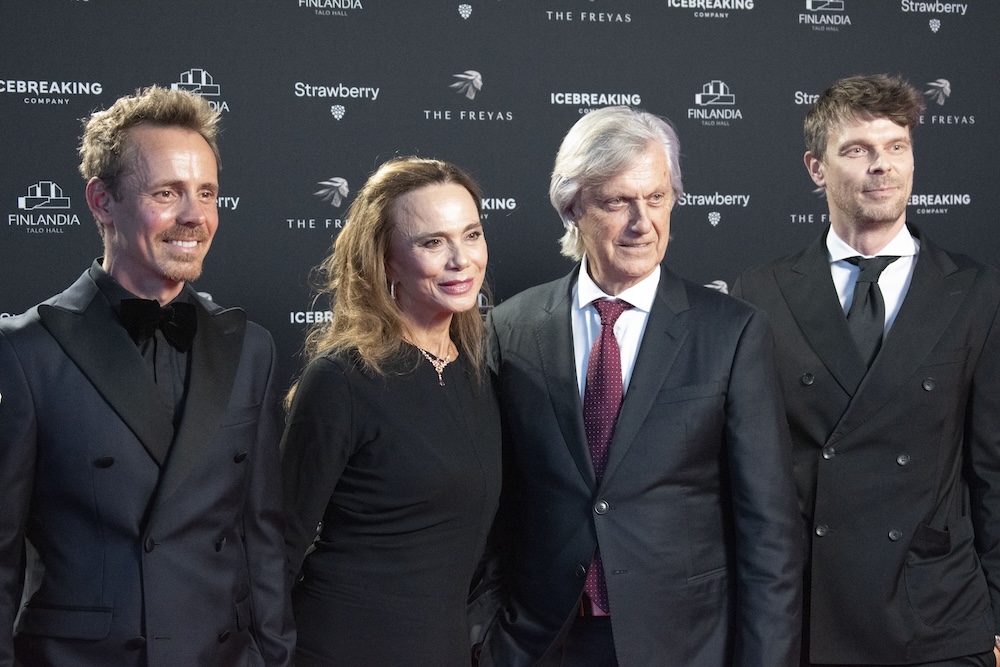
The red carpet outside Finlandia Hall was already beginning to fill with actors, filmmakers and industry guests when the meaning of the evening became visible in an unexpected form.
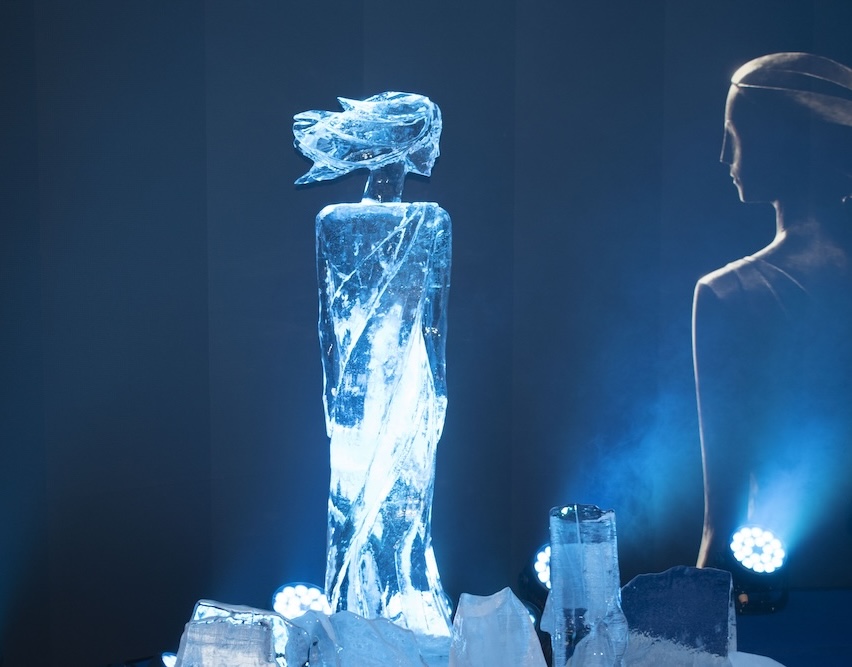
A real ice sculpture stood as part of the event’s visual setting, an unusually fitting object for a gala whose ambition was to break the ice between Nordic screen industries and the international film and television world.
Inside Finlandia Hall, the inaugural THE FREYAS – Nordic Film & TV Awards brought together some of the most recognizable names in Nordic cinema and television. Swedish, Finnish, Danish, Norwegian and Icelandic talent shared the same stage, while international media and industry professionals gathered in Helsinki for the launch of a new annual event designed to connect Nordic creativity with the global screen industry.
And unlike many awards ceremonies that arrive fully formed after decades of history, THE FREYAS was beginning its story that night.
THE FREYAS was conceived as more than an awards ceremony. Its stated ambition is to become an annual meeting place for the Nordic audiovisual industry and its international partners — bringing together actors, directors, producers, writers, cinematographers, composers and other creative professionals with journalists, distributors, agents, financiers and festival representatives. The event is designed to celebrate Nordic screen culture while also creating opportunities for future collaborations.
The first edition took place at Finlandia Hall on September 22, 2026, with Copenhagen planned as the host city for 2027. The organizers envision the gala travelling through Nordic and Baltic countries, creating a shared platform rather than another ceremony belonging exclusively to one national film industry.
The evening’s ice sculpture could hardly have been more appropriate. THE FREYAS itself has an Icebreaker Award, created to recognize younger Nordic talent whose work signals an international breakthrough. The inaugural Icebreaker went to Norwegian actress Thea Sofie Loch Næss, whose international work has included The Last Kingdom, Wisting, La Palma, So Long, Marianne and The Ugly Stepsister.
Another emerging performer, Icelandic actress Ebba Katrín Finnsdóttir, received the Valkyrie Award for her work in the crime drama series Hildur. Together, the two awards underlined one of the evening’s recurring themes: the importance of creating pathways for Nordic talent to cross borders.
Finnish filmmaker Hanna Bergholm’s Nightborn, starring Seidi Haarla and Rupert Grint, received the award for Outstanding Nordic Film. The award for Outstanding Nordic Series went to The Danish Woman, directed by Icelandic filmmaker Benedikt Erlingsson. Its Danish star Trine Dyrholm, who plays Ditte Jensen, also received the award for Outstanding Nordic Actor in a Series.
Ólafur Darri Ólafsson received the Outstanding Nordic Actor in a Series award for Reykjavik Fusion, while Swedish actor Fares Fares was recognized as Outstanding Nordic Actor in a Film for Adult Supervision.
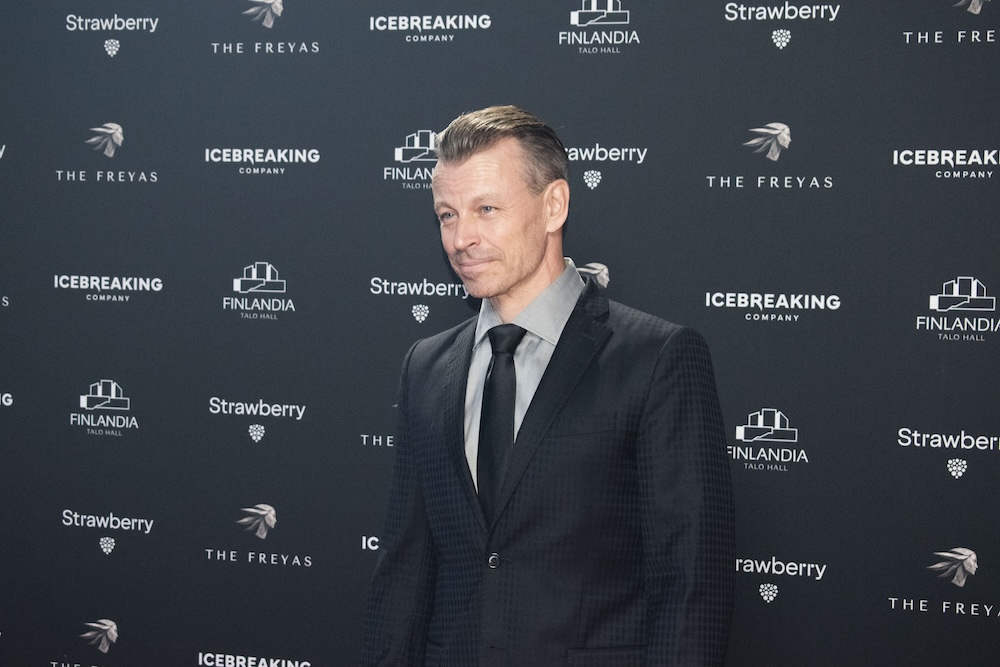
The Finnish presence at the event extended well beyond the venue. Actors and filmmakers including Alma Pöysti, Peter Franzén, Oona Airola, Ville Virtanen, Pekka Strang, Sara Soulié and Emmi Parviainen, together with directors including Dome Karukoski, Zaida Bergroth and Selma Vilhunen, were among the announced participants, presenters or jury members.
The Finnish contribution was also reflected in the Local Nordic Hero Award, presented to actress Laura Birn for her international contribution, particularly her role as Demerzel in Apple’s Foundation.
The Nordic Impact Award went to Finnish-Norwegian documentary The Secret Reading Club of Kabul, directed by Shakiba Adil and Elina Hirvonen. The award brought another dimension to the evening, extending the definition of Nordic screen culture beyond entertainment and international commercial success toward cinema’s ability to give visibility to people living under extreme political circumstances.
Swedish director Lasse Hallström received the Honorary Falcon Award, recognizing his contribution to connecting Nordic and international cinema. Finnish filmmaker Dome Karukoski, who presented the award, spoke about the lasting influence of My Life as a Dog on young Nordic directors and its combination of humanity and warmth.
Olin herself received the Honorary Goddess Award.
One of the most memorable conversations on the red carpet was with Olin, whose presence represented one of the evening’s central themes: a Nordic artist whose career has crossed continents. Olin has spent decades moving between Swedish and international cinema, and she now lives in New York. Yet when asked about the relationship between her American and European identities, she described something more fluid than a simple change of home.
“When I’m there I feel like a New Yorker,” she explained. “And when I come back to Europe I feel so European.”
That dual perspective made her particularly interesting to speak with at a gala explicitly concerned with Nordic creativity reaching the international stage.
Asked what makes Swedes successful in music and film — and whether there is something distinctive in the wider Nordic cultural environment — Olin pointed toward an attitude of allowing artists to be individual.
She suggested that Nordic artists have historically allowed themselves to be “a little off,” to be individualistic and to create without constantly stressing about whether something meets a predetermined idea of quality.
Then she reduced the idea to one simple word: Play.
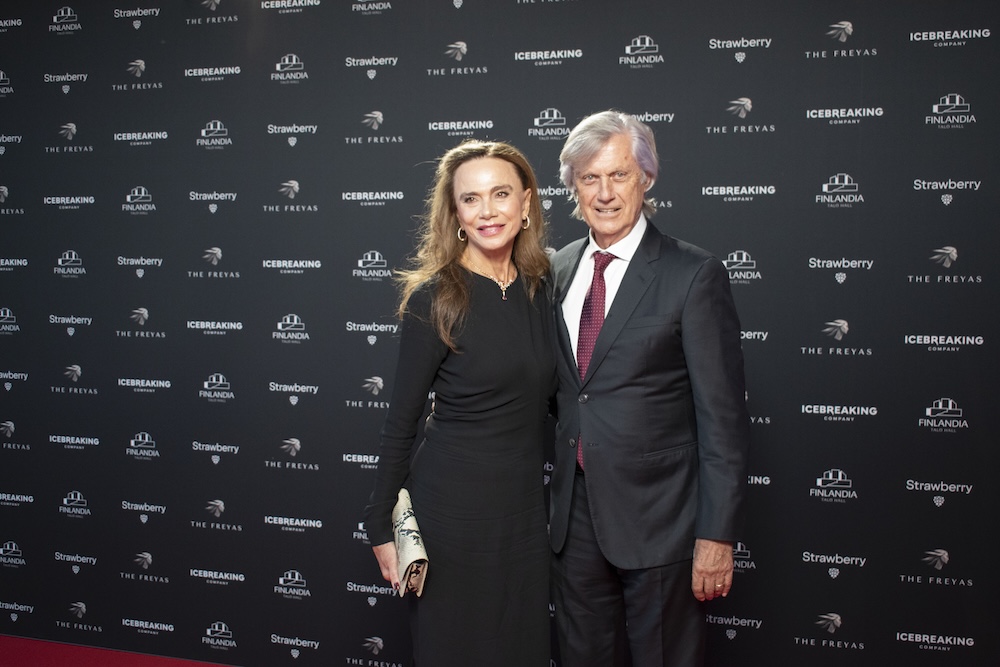
“I think it’s play. To play. To be… to have fun and to let each other play,” Olin said. “And that’s what we do, basically. A little too much maybe!” She laughed. “But I think it’s being able to play together.”
The idea of play also appeared in Olin’s reflections on acting. She recalled that when she began working in the Nordics, actors were reminded that acting was a privilege and that their task was to serve the story rather than themselves. International work later gave her a different perspective on the profession — one in which she increasingly experienced the opportunity to work as an honor.
Now, she said, she feels particularly proud when looking around at the generation of Nordic actors and filmmakers working today.
Olin was also asked about the experience of working with Lasse Hallström over a long period. Her answer was affectionate.
“Very easy. He’s a dream,” she said of the director.
But do they ever fight?
“Yes, yes, yes! We fight! Like all people do.”
The disagreements, she explained, can initially become quite dramatic. Then, afterwards, neither of them can remember exactly what the argument was about. She jokingly reconstructed the pattern: one person demanding an apology, the other insisting that they first need to “work it out.”
The conversation naturally turned toward Nordic cinema. Asked about Swedish filmmaking, Olin immediately referenced the enormous influence of Ingmar Bergman, joking that almost everyone she had spoken with at the event had mentioned him.
The red-carpet conversation also turned naturally toward Finnish cinema.
Asked about her favourite Finnish film, Olin initially admitted that she had seen too few Finnish films to confidently name one. Then the conversation turned to Aki Kaurismäki.
When the interviewer mentioned The Match Factory Girl and The Man Without a Past, Olin immediately recognized the films.
“Yes, yes, yes — there we go!” she laughed.
Olin’s connection to Lasse Hallström gave the evening another important international dimension. Hallström’s filmography includes My Life as a Dog, What’s Eating Gilbert Grape, The Cider House Rules and Chocolat, among others.
Olin spoke warmly about his films. She particularly praised Chocolat, observing how audiences continue returning to it, while also describing The Cider House Rules as an impressive achievement because it combines the scale of a major production with an intimate emotional quality.
When she watches it with her daughter, she said, she finds herself thinking: “Dear God, you actually made that movie!”
For Olin, that mixture of ambition and intimacy seems to be one of Hallström’s defining qualities.
Asked what role she would like to play next, her answer was immediate and theatrical. She would like to play a contemporary Lady Macbeth — a woman who pushes her husband too hard.
Then she laughed.
“Crazy!”
It was another moment that brought the conversation back to play, imagination and the freedom to inhabit characters far removed from one’s own life.
Asked about social media, Olin was equally candid, saying that Instagram is her platform of choice. She does not use X or other opinion-heavy platforms, preferring photographs and the ability to keep up with friends.
One of the most revealing moments of the interview came when Olin described the strange duality of a life divided between continents. She has lived in New York for around 30 years, yet she does not see the move as a complete transformation. In New York, she feels like a New Yorker; when she returns to Europe, however, she immediately feels European again. She even joked that friends in New York still regard her as somewhat foreign, while Europe feels like her “turf.”
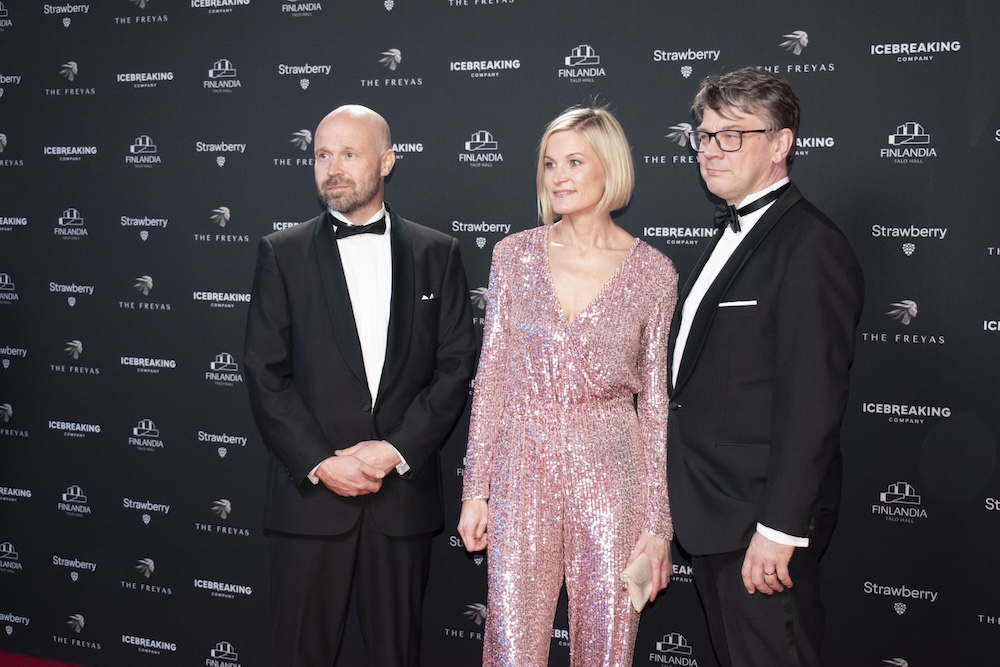
Against that personal dimension, the institutional ambition of THE FREYAS remained clear throughout the evening. The organizers have been explicit that the gala is intended to be about networking as much as awards. The goal is to bring together people who might otherwise meet only through individual productions, festivals or international markets.
That ambition was also emphasized before the ceremony by founder Kirpi Uimonen, who described the event as a way of bringing international industry networks into the Nordic region. The event’s guest list and international media attention reflected that broader objective.
The ceremony’s host, Finnish actor Pekka Strang, added his own characteristically Nordic perspective to the evening. Currently shooting the fourth season of The White Lotus, Strang joked about Finland’s famously limited summer and suggested that the country’s silence, darkness and grey landscapes may have helped create the atmosphere later associated with Nordic noir.
The joke worked because Nordic cinema has long transformed geographical and cultural specificity into an international cinematic language.
THE FREYAS is now attempting to build an institutional counterpart to that phenomenon.
Rather than presenting Nordic cinema as a collection of separate national industries, the awards are positioning the region itself as a creative network — one in which a Finnish film can compete alongside Danish and Icelandic productions, Swedish actors can move between Hollywood and Scandinavia, and filmmakers can discover new collaborators across borders.
The first ceremony therefore functioned simultaneously as an awards night, an industry gathering and a statement of intent.
The ice outside Finlandia Hall became more than decoration. It echoed the name of one of the evening’s awards, the event’s networking mission and the broader idea of Nordic talent crossing borders.
It was, quite literally, an icebreaking gala.
And the next chapter is already planned.
Copenhagen will host the 2027 edition, after which the ceremony is intended to continue travelling through Nordic and Baltic locations. The travelling model gives the awards an opportunity to develop a distinct identity in each host city while maintaining a common Nordic framework.
From Helsinki to Copenhagen and beyond, THE FREYAS has begun its journey by attempting something deceptively simple: bringing a region that has traditionally been divided into national screen industries into the same room — and giving its filmmakers a reason to keep talking to one another.